
Vacuum Insulating Glass (VIG)
Key Facts
- U-value ≤ 0.45 W/(m²·K) — ≈ 4× better than standard insulating glass
- Total thickness ≈ 8.3 mm: passive-house performance in a retrofit-friendly pane
- Sound insulation up to 42 dB — vacuum blocks airborne noise transmission
- Internal vacuum 0.01 Pa; internal dew point below −60 °C (no internal condensation)
- Fully tempered safety glass, no pump-out port, lead-free edge sealing
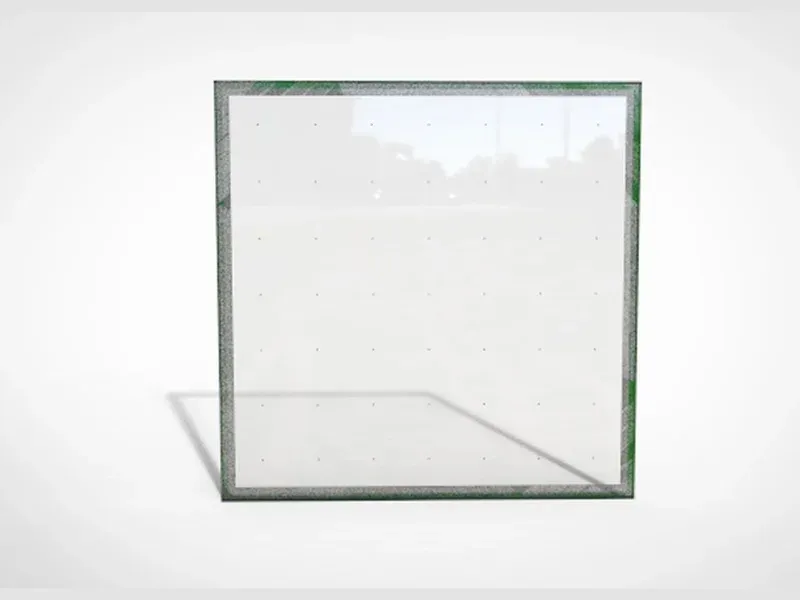
Vacuum insulating glass (VIG) consists of two glass panes separated by a 0.3 mm evacuated gap sealed at the edges with a lead-free alloy solder. With the cavity evacuated to 0.01 Pa, gas conduction and convection disappear, giving a center-of-glass U-value of ≤ 0.45 W/(m²·K) — about four times better than conventional double glazing, in a unit less than half the thickness of triple glazing.
Supertech VIG is fully tempered and produced on a continuous line without a pump-out port, eliminating the visual stem and the classic slow-leak failure point. A built-in getter maintains the vacuum over the service life.
Why architects choose VIG
Passive-house U-values at 8.3 mm
A triple-glazed Low-E unit needs 36–44 mm and heavy frames to reach a similar U-value. VIG delivers it in ≈ 8.3 mm and roughly one third of the weight — ideal where frame depth, sightlines or sash capacity are limited.
Heritage and retrofit ready
Because VIG fits existing single-glass rebates, historic windows can be upgraded to modern energy codes without replacing frames — a growing requirement in EU renovation programs.
Quiet by physics
Sound needs a medium; a vacuum has none. VIG achieves up to 42 dB weighted sound reduction, outperforming much thicker laminated assemblies on traffic-noise frequencies.
Engineered for longevity
Fully tempered panes, lead-free alloy edge sealing without an extraction port, and an internal getter that keeps the vacuum at 0.01 Pa — the failure modes of first-generation VIG are designed out.
Technical Specifications
| Property | Value |
|---|---|
| U-value (center of glass) | ≤ 0.45 W/(m²·K) |
| Comparison | ≈ 4× the thermal performance of standard double-glazed insulating glass |
| Total thickness | ≈ 8.3 mm (4 + 0.3 V + 4); other builds and hybrid IGU laminates available |
| Internal vacuum | 0.01 Pa, maintained by built-in getter |
| Sound insulation | Up to 42 dB (weighted) |
| Internal dew point | Below −60 °C — no internal condensation in service |
| Glass type | Fully tempered safety glass; Low-E coating options |
| Edge seal | Lead-free alloy solder; no pump-out port (flat, all-glass appearance) |
| Weight vs. triple glazing | Roughly one third at comparable U-value |
Applications
- Passive-house and near-zero-energy building windows
- Curtain walls and slim-profile facade systems
- Heritage window retrofit within existing frames
- Glass doors for commercial freezers and refrigerated display
- Skylights, conservatories and noise-critical facades