
Vacuum Insulating Glass vs. Triple Glazing: U-Value, Thickness, Weight
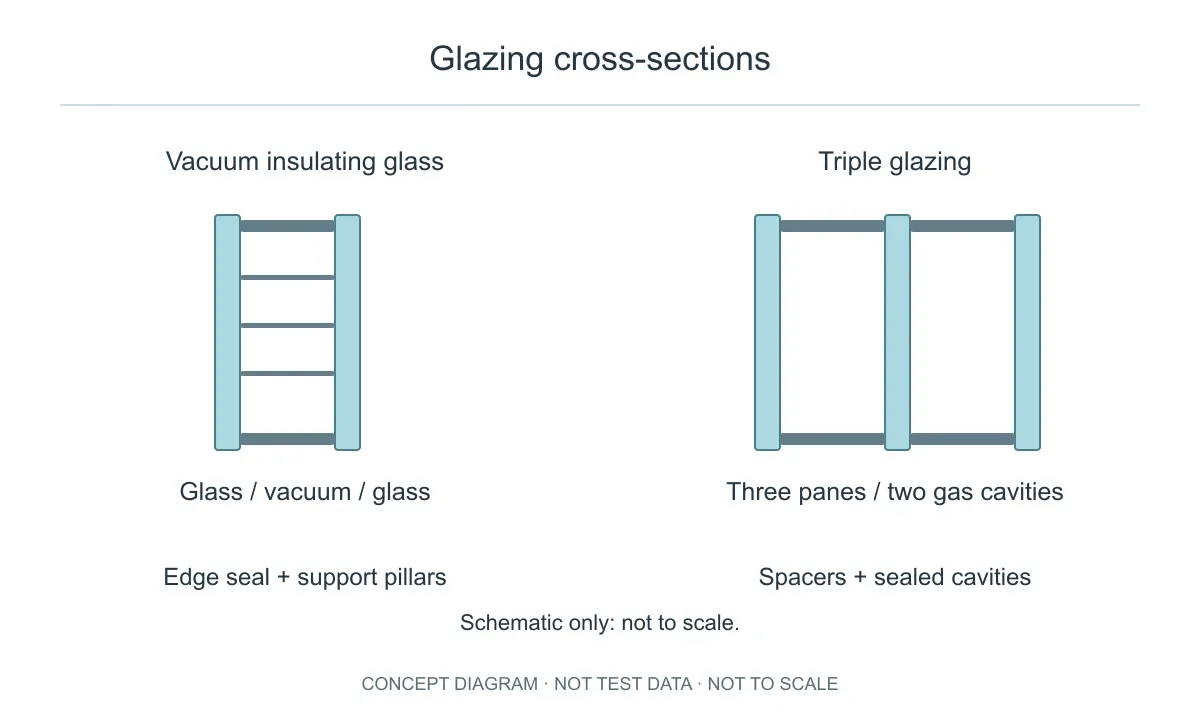
Key numbers
- VIG: U ≤ 0.45 W/(m²·K) at ≈ 8.3 mm, ~20 kg/m².
- Triple glazing: U 0.5–0.8 W/(m²·K) at 36–44 mm, ~30–45 kg/m².
- Double glazing (air): U 2.6–2.8 · Double Low-E argon: U 1.1–1.3.
- VIG sound insulation: up to 42 dB; no internal condensation (dew point < −60 °C).
Side-by-side comparison
| Property | Vacuum insulating glass | Triple glazing (Low-E, argon) | Double glazing (Low-E, argon) |
|---|---|---|---|
| U-value W/(m²·K) | ≤ 0.45 | 0.5–0.8 | 1.1–1.3 |
| Total thickness | ≈ 8.3 mm | 36–44 mm | ≈ 24 mm |
| Weight | ≈ 20 kg/m² | 30–45 kg/m² | ≈ 20 kg/m² |
| Sound reduction | up to 42 dB | 32–36 dB | 30–34 dB |
| Fits existing single-glass frames | Usually yes | No | Rarely |
| Internal condensation risk | None (vacuum, dew point < −60 °C) | Low (desiccant-dependent) | Low (desiccant-dependent) |
Where VIG wins
- Retrofit and heritage: at 8.3 mm it drops into rebates made for single glass — no frame replacement, which is usually most of a window project's cost.
- Slim facades and big sashes: one third of triple glazing's weight means lighter hardware, larger openable units and slimmer sightlines.
- Noise-critical sites: the vacuum gap physically blocks airborne sound transmission.
- Cold-face applications: freezer and cooler doors stay condensation-free without heater wires.
Where triple glazing wins
- Lowest unit price in new-build volumes where frame depth is already designed for 40+ mm units.
- Whole-window optimization: mature spacer/frame ecosystems for standard IGU dimensions.
Hybrid builds — a VIG pane laminated into a conventional IGU — combine both worlds and reach U-values around 0.3 W/(m²·K) for passive-house certification with standard frame systems.
Frequently asked questions
Is vacuum glazing better than triple glazing?
For thermal performance per millimeter, yes: vacuum insulating glass reaches U ≤ 0.45 W/(m²·K) at about 8.3 mm total thickness, while triple glazing needs 36–44 mm for 0.5–0.8. Triple glazing remains competitive where frame depth is unlimited and lowest unit price matters.
How thick is vacuum insulating glass?
A typical unit is about 8.3 mm: two 4 mm tempered panes separated by a 0.3 mm evacuated gap. That is thinner than most standard double glazing (24 mm) and roughly a quarter of a triple-glazed unit.
Does vacuum glazing help with noise?
Yes. Airborne sound cannot cross a vacuum, so VIG achieves up to 42 dB weighted sound reduction — better than much thicker conventional units, especially in traffic-noise frequencies.
Related: Supertech VIG specifications ·Applications overview