
Insulation Thickness, Explained: Same R-Value at 1/10 to 1/20 the Thickness
TL;DR
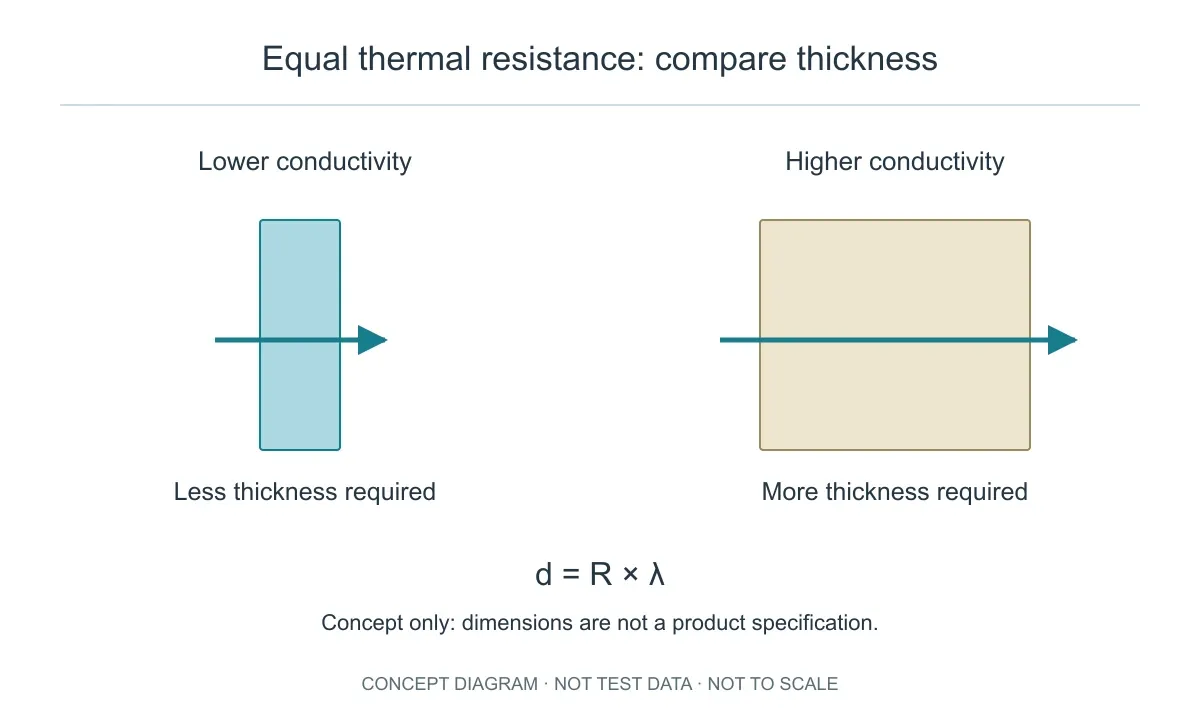
- Required thickness = target R × material λ. Halve the λ, halve the wall.
- For R ≥ 2.5 (m²·K)/W: rock wool ≈ 100 mm, PU foam ≈ 50 mm, VIP ≈ 5 mm.
- That is a 90–95% thickness reduction at equal thermal performance.
- On a pipe run, switching from 100 mm rock wool to VIP frees roughly 600 cm² of cross-section per linear meter.
- Where space has a price — pipe corridors, cold rooms, interior retrofits, appliance walls — thickness is money.
The three numbers that decide how thick insulation must be
Every insulation thickness decision comes down to three related quantities. Get these straight and the "90% thinner" headline stops being marketing and becomes arithmetic.
λ — thermal conductivity, W/(m·K)
A pure material property, independent of thickness: how fast heat moves through the material. Rock wool sits around 0.040 W/(m·K), polyurethane foam around 0.020, and a vacuum insulation panel between 0.0015 and 0.003 — an order of magnitude below both.
R — thermal resistance, (m²·K)/W
The engineering target. R = d ÷ λ: thickness divided by conductivity. Specifications are written in R (or its inverse U) because it describes the finished layer, not the raw material.
K (U) — heat transfer coefficient, W/(m²·K)
The inverse view: K = λ ÷ d, the actual heat flow per square meter per degree of temperature difference. Lower K means lower energy loss.
The thickness table: reaching R ≥ 2.5 (m²·K)/W
R = 2.5 is a common benchmark for equipment and cold-service insulation. Rearranging the formula to d = R × λ gives the required thickness per material:
| Material | λ, W/(m·K) | Required thickness | vs. VIP |
|---|---|---|---|
| Vacuum insulation panel | 0.002 | 5 mm | 1× |
| Polyurethane foam | 0.020 | 50 mm | 10× |
| Rock wool | 0.040 | 100 mm | 20× |
Same R, same thermal performance — at one tenth to one twentieth of the material thickness. The physics behind the low λ (evacuated core removing gas conduction and convection, micro-porous structure throttling solid conduction, barrier film limiting radiation) is covered in our reference explainer: what is a vacuum insulation panel?
Four places where thickness is the real constraint
1. Industrial pipe and equipment insulation
A cold-service line wrapped in 100 mm of rock wool grows by 200 mm in diameter. In a pipe corridor that means fewer lines per rack, heavier supports and blocked maintenance access — a common reason renovation projects stall. Replacing 100 mm wool with a thin VIP build-up frees roughly600 cm² of cross-section per meter of pipe, often the difference between a feasible retrofit and a rejected one.
2. Cold rooms and refrigerated vehicles
Every centimeter of wall build-up is cargo or storage volume lost on the inside. Reefer bodies and walk-in cold rooms built with VIP composite panels reclaim that volume without sacrificing the U-value.
3. Interior retrofits with fixed external walls
When the facade cannot change — heritage buildings, terraces, city apartments — insulation grows inward and eats floor area. At property prices of several thousand euros per square meter, a 15 mm VIP instead of a 175 mm EPS build-up preserves real money; the numbers are worked through inVIP vs. traditional insulation.
4. Appliances and equipment housings
Refrigerator cabinets, water heaters and vending machines cannot grow outward — the product footprint is fixed by the kitchen and the doorway. Thinner walls translate directly into interior volume, which is why high-end appliance makers were the first mass adopters of VIPs.
Designing with thin build-ups: three practical notes
- Edge effects. The barrier envelope conducts some heat around panel edges, so effective λ is slightly above center-of-panel values — layouts should favor large panels and staggered joints.
- No site cutting. VIPs are factory-made to size; dimension surveys happen before production, with filler strips for tolerances.
- Temperature range. Standard panels serve −70 °C to +80 °C; for hot process lines, the high-temperature series extends from −196 °C to +800 °C.
Frequently asked questions
How do I calculate the insulation thickness needed for a target R-value?
Use d = R × λ: required thickness equals the target thermal resistance multiplied by the material's thermal conductivity. For R = 2.5 (m²·K)/W, rock wool at λ = 0.04 W/(m·K) needs 100 mm, PU foam at 0.02 needs 50 mm, and a vacuum insulation panel at 0.002 needs just 5 mm.
Can vacuum insulation panels replace rock wool on industrial pipes?
For lines operating between −70 °C and +80 °C, standard VIPs are a direct space-saving alternative. For hot process lines, Super Tech's high-temperature VIP series covers −196 °C to +800 °C. The panels are factory-made to size, so pipe diameter and fitting layouts are engineered before production.
What is the thinnest insulation available for a given performance?
Vacuum insulation panels are currently the thinnest industrial insulation in commercial use: with a thermal conductivity of 1.5–3 mW/(m·K), they reach a given R-value at roughly one tenth to one twentieth of the thickness of conventional fibrous or foam materials.
Related: Supertech VIP specifications ·VIP vs. traditional insulation — the numbers ·Applications overview