
VIP vs. Traditional Insulation: Thermal Conductivity and R-Value Compared
Key numbers
- VIP: 1.5–3.0 mW/(m·K) · PU foam: 20–25 · XPS: 30–35 · EPS: 33–38 · mineral wool: 35–45.
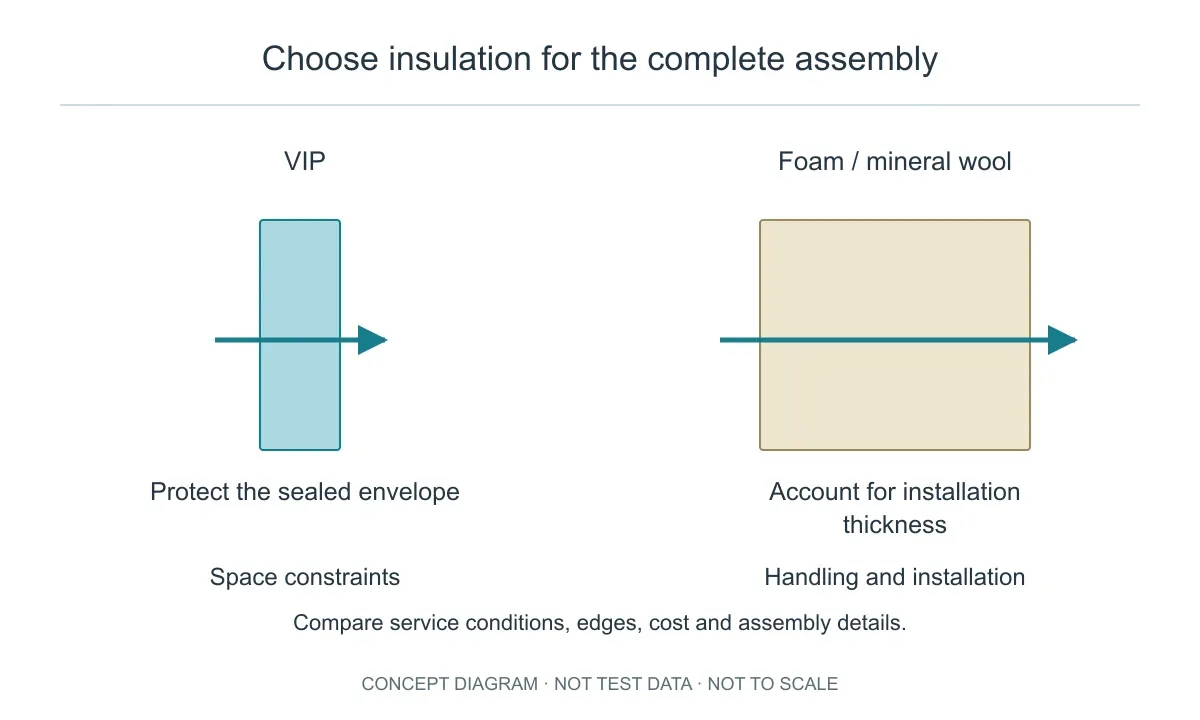
- Same insulation: 15 mm VIP ≈ 75–100 mm PU ≈ 220–280 mm mineral wool.
- Per inch: VIP ≈ R-25…R-40; PU ≈ R-6.5; EPS ≈ R-4.
- VIP wins where space, weight or volume has monetary value.
The comparison table
| Material | Thermal conductivity mW/(m·K) | Approx. R-value per inch | Thickness for U = 0.2 W/(m²·K) |
|---|---|---|---|
| Vacuum insulation panel (VIP) | 1.5–3.0 | R-25 – R-40 | ≈ 10–15 mm |
| Polyurethane foam (PU/PIR) | 20–25 | ≈ R-6.5 | ≈ 110 mm |
| Extruded polystyrene (XPS) | 30–35 | ≈ R-5 | ≈ 160 mm |
| Expanded polystyrene (EPS) | 33–38 | ≈ R-4 | ≈ 175 mm |
| Mineral wool / glass wool | 35–45 | ≈ R-3.5 | ≈ 200 mm |
What the numbers mean in practice
Appliances: interior volume is revenue
In a refrigerator cabinet, replacing 60–80 mm of PU foam with a 10–20 mm VIP frees up to 20% more interior volume in the same external footprint — the difference between a 300 L and a 360 L product on the same shelf space, and often the difference between energy classes.
Cold chain: holding time and freight cost
A shipping box with VIP walls holds +2…+8 °C for up to 120 hours where an EPS box manages 24–48. Because the walls are 4–5× thinner, the same external carton carries up to 40% more payload — directly lowering dimensional-weight freight cost per unit.
Buildings: floor area is money
Meeting a wall value of U = 0.2 W/(m²·K) takes roughly 11 cm of PU or 20 cm of mineral wool — or about 1.5 cm of VIP. On a 100 m² apartment in a city where floor space sells for thousands of dollars per square meter, insulating internally with VIP instead of foam can preserve several square meters of sellable area.
Where traditional materials still win
- Unconstrained space: if the wall can simply be thicker, bulk insulation is cheaper per R.
- Site adaptability: wool and EPS can be cut and fitted on site; VIPs cannot.
- Puncture-prone environments: areas with uncontrolled drilling or fixing need protective design around VIPs.
In practice, high-performance designs combine both: VIP for the field area, conventional material at edges, penetrations and cut-to-fit zones.
Frequently asked questions
How much better is a VIP than PU foam?
At the same thickness, a vacuum insulation panel conducts roughly 5–10 times less heat than polyurethane foam: 1.5–3.0 mW/(m·K) versus 20–25 mW/(m·K). Put differently, a 15 mm VIP insulates like 75–100 mm of PU foam.
What R-value does a vacuum insulation panel have?
Per inch of thickness, VIPs reach roughly R-25 to R-40 (imperial), compared with about R-6.5 for polyurethane foam and R-4 for EPS. Effective values depend on panel size because of edge effects, so engineering layouts use the effective, not center-of-panel, value.
When is traditional insulation the better choice?
When space is free and cheap. If a wall can simply be 20 cm thicker, mineral wool or EPS wins on cost. VIPs pay off when every centimeter has value: refrigerator cabinets, cold-chain boxes, terraces, interior retrofits, floor space in high-rent cities.
Related: What is a VIP? ·Supertech VIP specifications