
Tempered Vacuum Insulating Glass: How Fully Tempered VIG Works
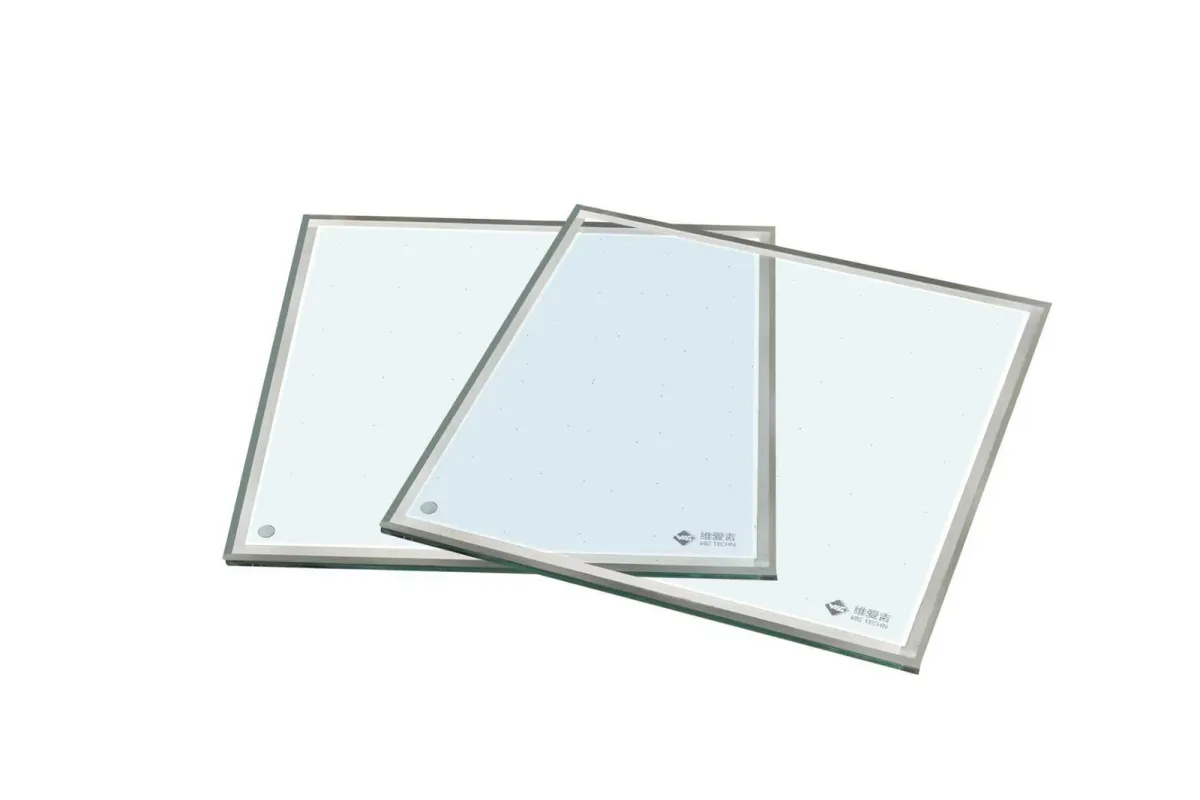
TL;DR
- Tempering and vacuum sealing were incompatible for decades: the traditional edge seal was fired hot enough to anneal the glass and erase the temper.
- Low-temperature edge sealing solved it — the panes keep their full temper through the sealing process.
- Fully tempered VIG is safety glass and high-performance insulation in one ≈ 8.3 mm unit (U ≤ 0.45 W/(m²·K)).
- Tempering also raises resistance to thermal stress — critical for freezer doors and sun-exposed facades, where the two panes of a VIG naturally sit at very different temperatures.
- It unlocks the applications building codes reserve for safety glass: doors, full-height partitions, overhead and door-adjacent glazing.
Why tempering matters in glazing
Building codes worldwide require safety glass wherever people can walk into or fall against a pane: doors and door-adjacent panels, full-height glazing, partitions, balustrades and overhead applications. Fully tempered glass qualifies because of how it breaks — into small, blunt granules instead of dagger-like shards. It is also four to five times stronger than annealed glass of the same thickness against both impact and temperature-difference stress.
For conventional insulating glass, tempering is routine. For vacuum insulating glass it was, for a long time, physically impossible — which confined first-generation VIG to windows and kept it out of doors, partitions and refrigeration, some of its most natural markets.
Why VIG and tempering were incompatible
Tempering works by heating glass to about 620 °C and quenching the surfaces with air jets. The surfaces solidify first and end up in permanent compression — that locked-in stress layer is the temper. The catch: reheat the glass above roughly 300 °C and the stress relaxes. The temper quietly anneals away.
First-generation VIG was sealed with solder glass (glass frit) that had to be fired at around 400–500 °C — well past that limit. Whatever entered the furnace tempered came out annealed. The vacuum was preserved; the safety performance was not. That single process constraint, more than any market factor, kept vacuum glazing niche for twenty years.
What changed: sealing below the tempering limit
The breakthrough was edge-sealing chemistry that bonds glass hermetically at temperatures the temper survives. Current production — including Supertech's continuous line — combines three elements:
- Low-temperature, lead-free alloy edge sealing. A metal-alloy solder wets and bonds the glass edge without approaching the stress-relaxation zone, and does it RoHS-compliantly (early solder glasses were lead-based).
- Port-free evacuation. The cavity is evacuated to ≈ 0.01 Pa before final sealing on the line, eliminating the pump-out stem on the face of the glass — historically both a visual complaint and the most common slow-leak site.
- An internal getter that chemically binds residual and permeating gas molecules over the service life, keeping the vacuum at its design level.
The result is a fully tempered unit of two 4 mm panes and a 0.3 mm evacuated gap — ≈ 8.3 mm in total — delivering a center-of-glass U-value of ≤ 0.45 W/(m²·K). The performance numbers and how they compare with conventional build-ups are inour VIG vs. triple glazing comparison.
The quieter benefit: thermal stress resistance
A vacuum unit insulates so well that its two panes routinely sit at very different temperatures — that is the point of the product. But temperature difference means differential expansion, and differential expansion means stress. Annealed glass tolerates roughly a 40 K difference across a pane before spontaneous breakage becomes a design concern; tempered glass tolerates several times more.
That margin is exactly what freezer and refrigeration doors, dark-framed facades in full sun, and unheated-to-heated transitions demand. Tempering is not only a safety feature in VIG — it is what makes the thermal performance safely usable at its extremes.
What tempered VIG unlocks
- Doors and door-adjacent glazing — safety glass required by code, slim rebates required by the joinery.
- Full-height partitions and interior glazing — with the 42 dB sound reduction of a vacuum cavity as a bonus.
- Refrigeration and freezer doors — the same physics that insulates a wall keeps a display door condensation-free without heater wires.
- Renovation and heritage windows — where an 8.3 mm unit fits existing single-glass rebates; the space math is in the product specification.
Specifying it: three practical notes
- Ask for the safety-glass certificate for your market (EN 12150 in Europe, ANSI Z97.1/CPSC 16 CFR 1201 in North America) — "tempered" on a datasheet is a claim; the fragmentation test report is the evidence.
- Confirm edge-seal chemistry. Lead-free alloy sealing matters for RoHS-relevant projects and public procurement.
- Design to final size. Like every hermetically sealed unit, tempered VIG cannot be cut, drilled or notched after production — dimensions and cutouts are engineered before the line, not on site.
Frequently asked questions
Can vacuum insulating glass be tempered?
Yes. Early VIG could not be tempered because its edge seal was fired at temperatures that anneal the glass, but modern low-temperature sealing processes preserve the temper. Fully tempered VIG — such as Supertech's production units — combines safety-glass behaviour with a center-of-glass U-value of ≤ 0.45 W/(m²·K).
Why could first-generation vacuum glazing not use tempered glass?
Tempering works by locking a compressive stress layer into the glass surface. That stress relaxes when the glass is reheated above roughly 300 °C — and traditional solder-glass edge seals were fired at around 400–500 °C, which effectively annealed the panes. The fix was edge-sealing chemistry that bonds at temperatures the temper survives.
Is tempered VIG a safety glass?
The panes are fully tempered, so they fracture into small granules rather than shards, as defined by tempered-glass standards such as EN 12150. As with any glazing product, ask the supplier for the safety-glass certification applicable to your market and application before specifying it in doors, partitions or overhead glazing.
References
- ISO 19916-1 — Glass in building. Vacuum insulating glass. Basic specification of products and evaluation methods.
- EN 673 — Glass in building. Determination of thermal transmittance (U value).
- EN 12150 — Glass in building. Thermally toughened soda lime silicate safety glass.
Related: Supertech tempered VIG specifications ·Vacuum glass vs. triple glazing ·Applications overview