
How to Verify a Vacuum Insulation Panel Lifespan Claim
What a credible lifespan claim must contain
- “10 years” or “25 years” is incomplete unless the supplier defines the end-of-life thermal threshold.
- The claim must be tied to a specific core, barrier laminate, seal design, getter/desiccant system, panel size and thickness.
- Temperature and humidity drive permeation; puncture and seal damage create a separate, faster failure path.
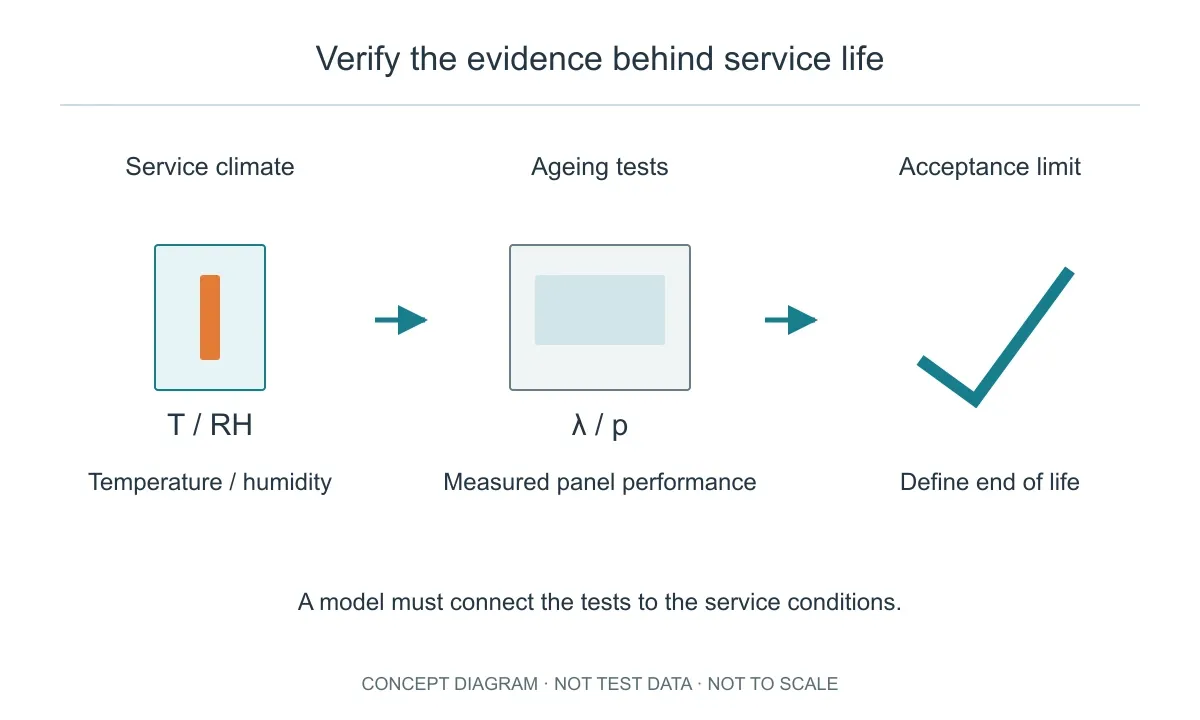
- Accelerated aging is evidence, but test hours do not convert directly into field years without a validated model.
- Ask for both center-of-panel aging and the effective result including edges, joints and installation protection.
Start by defining “end of life”
A vacuum insulation panel rarely has a simple expiry date. Its thermal conductivity normally rises over time as gas and water vapor enter the envelope. The useful service life ends when the panel or insulated assembly no longer meets a defined requirement, not when every trace of vacuum disappears.
That requirement might be a maximum center-of-panel conductivity, a minimum effective R-value, a refrigerator energy target, a building design value or a qualified cold-chain holding time. Published research has used criteria such as a specified percentage increase in conductivity, but that threshold is not universal. The purchaser must connect the end-of-life criterion to the application.
Three different degradation paths
| Path | What happens | Typical evidence | Design response |
|---|---|---|---|
| Dry-gas permeation | Internal pressure slowly rises and gas conduction increases | Barrier permeance, pressure response of core, aged λ | High-barrier envelope, reliable seal, suitable core and getter |
| Water-vapor ingress | Moisture raises solid conduction and changes core behavior | WVTR, mass uptake, sorption data, hot/humid aging | Moisture barrier, desiccant capacity and environmental protection |
| Mechanical loss of vacuum | Puncture, cracked fold or seal failure causes rapid degradation | Damage inspection, leak test, drop/vibration/compression result | Protective skin, recessed mounting, edge guards and rejection rules |
A long permeation-based prediction does not cover accidental damage. Conversely, a robust drop test does not prove that gas and moisture ingress will remain low for decades. Both evidence streams are needed for a complete durability claim.
Why panel size, thickness and edges belong in the claim
Gas and moisture enter through the envelope area and sealed perimeter, while the core volume and adsorbent capacity determine how much ingress the panel can tolerate. This means the aging behavior of a large, thick panel cannot automatically be transferred to a smaller or thinner one. Fold geometry, seal width and the ratio of perimeter to area also change the result.
Edges introduce a second issue: heat can bypass the low-conductivity core through metallized or foil layers. ASTM C1667 measures center-of-panel transmission, while the effective installed result must also account for edge thermal bridges, joints and the surrounding assembly. A lifespan claim based only on the best point at the center can overstate long-term system performance.
The evidence ladder: from brochure number to engineering claim
| Supplier statement | Minimum supporting information | What remains unknown |
|---|---|---|
| “Initial λ = X” | Test method, mean temperature, thickness, sample age and center/whole-panel basis | Rate of change and end-of-life performance |
| “Passed accelerated aging” | Temperature, RH, duration, sample count, dimensions, pre/post λ and failures | Calendar-life conversion unless a validated model is supplied |
| “25-year service life” | End threshold, service climate, barrier/core construction, geometry, model inputs and aged data | Damage risk and performance in a different application |
| “Suitable for the system lifetime” | Assembly protection, edge-adjusted result, mechanical tests, inspection and replacement plan | Effect of uncontrolled installation or operating changes |
What barrier, core and getter each contribute
The barrier laminate and seal control how fast gas and moisture enter. Their performance must be assessed at relevant temperatures because permeability changes with environmental conditions. A raw-film transmission value is useful, but folds, seals and production variability determine the finished panel.
The core determines how strongly conductivity responds to increasing pressure and moisture. Fumed silica and fiberglass therefore need different vacuum, envelope and adsorbent strategies. Our core-material comparisonexplains that pressure response; it should not be confused with a complete service-life prediction.
A getter or desiccant adds finite capacity for residual and permeating gases or water vapor. It can extend the performance window, but it does not make the envelope perfectly impermeable. Its type, quantity, activation and compatibility with the core must match the intended life and climate.
Use accelerated aging without inventing calendar years
High-temperature and high-humidity exposure can reveal weak laminates, seals and moisture management much faster than normal storage. It is valuable for screening and for calibrating a model. But a result such as “1,000 hours at 85 °C/85% RH” is not, by itself, equivalent to a stated number of years in a refrigerator, facade or shipping box.
A defensible conversion needs the permeation or acceleration relationship, actual service temperature and humidity distribution, panel geometry, core sorption behavior, end threshold and uncertainty. Field data should be used to challenge the model rather than merely confirm the sales claim.
Application claims are not interchangeable
Appliances
The relevant target is usually the appliance design life and energy performance. Foam encapsulation can protect panels well, but manufacturing pressure, cabinet forming and local damage still need controls.
Buildings
ISO 16478:2023 defines requirements, aging factors and edge-bridge treatment for silica- and glass-fiber-core VIPs used in buildings. Its service-life evidence belongs to that product scope and protected building application; it should not be copied unchanged to a battery or reusable shipper.
Reusable cold-chain systems
Calendar age is only one control. Trip count, impact history, cleaning, closure wear and periodic thermal verification may provide a more practical retirement rule. Qualification belongs to the complete pack-out, not the loose panel.
Battery and industrial assemblies
Temperature cycling, vibration, compression, electrical requirements and unusual temperature ranges must be validated in the actual integration. A building-grade aging declaration does not prove safety or performance in those conditions.
Eight fields to put in a VIP lifespan specification
- Application and protected assembly: where the panel sits and how it is mechanically protected.
- Required service period: calendar years, controlled trips or another measurable duty cycle.
- End-of-life threshold: maximum λ, minimum R-value or system-level performance limit.
- Operating environment: temperature/RH profile, cycling, condensation and storage conditions.
- Panel definition: core, barrier, seal, getter/desiccant, size, thickness and edge geometry.
- Evidence: initial and aged thermal results, sample count, methods and failure distribution.
- Prediction method: model assumptions, acceleration relationship, uncertainty and applicability limits.
- Lifecycle controls: receiving inspection, damage criteria, traceability, monitoring and replacement process.
Frequently asked questions
How long does a vacuum insulation panel last?
There is no universal number. A defensible service-life statement must define the panel construction, size and thickness, operating temperature and humidity, mechanical protection, end-of-life thermal threshold, test data and prediction method. Without those conditions, a number of years is only a marketing claim.
Does an 85 °C/85% RH aging test prove a 25-year VIP lifespan?
Not by itself. Accelerated exposure is useful for comparing constructions and detecting weaknesses, but converting test hours into calendar years requires a validated acceleration model and a justified relationship to the real temperature and humidity profile. Pre- and post-test thermal data and failure rates must also be disclosed.
Do vacuum insulation panels fail suddenly or gradually?
Both modes are possible. Slow gas and water-vapor permeation normally causes a gradual rise in thermal conductivity. A puncture, cracked fold or failed edge seal can cause a much faster loss of vacuum. The protection and inspection plan must address both.
Can a punctured vacuum insulation panel be repaired?
A field patch may close the outer film but cannot reliably restore the original vacuum, moisture condition and getter state. For qualified applications, a punctured or suspect panel is normally rejected and replaced according to documented acceptance criteria.
References
- ISO 16478:2023 — specification, aging factors and edge thermal bridges for building VIPs.
- ASTM C1484 — general VIP specification covering barrier permeance, mechanical properties and thermal performance considerations.
- ASTM C1667 — center-of-panel thermal transmission measurement by heat-flow meter apparatus.
- Schwab et al., Prediction of Service Life for Vacuum Insulation Panels — permeation-based service-life modeling for fumed-silica VIPs.
- Li et al., Scientific Reports (2023) — influence of gas barriers, temperature and humidity on VIP service life.
Related: Supertech vacuum insulation panels ·Fumed silica vs. fiberglass cores ·How a VIP works ·Discuss your service-life requirement