
Fumed Silica vs. Fiberglass VIP Cores: Which One Should You Specify?
TL;DR
- Fiberglass core: lowest initial λ (typically 1.5–2.5 mW/(m·K)) and lower cost — the standard choice for appliances and cold-chain boxes.
- Fumed silica core: higher initial λ (≈ 3.5–5 mW/(m·K)) but orders of magnitude more tolerant of internal pressure rise — the choice for 15–25+ year building applications.
- The real difference is not day-one performance but how each core ages as gas slowly permeates the envelope.
- Both cores are inorganic and non-combustible (Class A core material).
- Supertech manufactures both core types in-house, so this comparison has no horse in the race — only the application decides.
Why the core material decides how a VIP ages
A vacuum insulation panel is a micro-porous core board evacuated and sealed inside a multi-layer barrier envelope (the full anatomy is in our reference explainer:what is a vacuum insulation panel?). The envelope and getter control how fast gas gets in; the core controls how much that incoming gas hurts. Two core families dominate commercial production — centrifugal glass fiber and fumed silica — and they answer that question very differently.
The comparison table
| Property | Fiberglass core | Fumed silica core |
|---|---|---|
| Initial λ, center of panel | 1.5–2.5 mW/(m·K) | 3.5–5 mW/(m·K) |
| Internal pressure for rated performance | High vacuum, < ≈ 0.1 mbar | Holds low λ up to several mbar |
| Sensitivity to pressure rise | High — λ climbs quickly once vacuum degrades | Low — flat λ curve across early-life pressure rise |
| Getter / desiccant | Getter essential | Desiccant; getter optional |
| Typical design service life | >10 years (appliances, shippers) | 15–25+ years (building, per EN 17140) |
| Core density | ≈ 200–300 kg/m³ | ≈ 160–220 kg/m³ |
| Fire behaviour of core | Non-combustible, inorganic | Non-combustible, inorganic |
| Relative cost per panel | Lower | Higher (fumed silica raw material) |
| If the envelope is punctured | Reverts toward conventional glass-fiber insulation | Reverts to ≈ 20 mW/(m·K) — still a working insulator |
The physics: pore size vs. the mean free path of air
At atmospheric pressure, an air molecule travels roughly 70 nanometers before colliding with another molecule. Gas-phase heat conduction needs those collisions — so if the pores of a material are smaller than the distance molecules travel between collisions, gas conduction is suppressed even when gas is present. This is the Knudsen effect, and it is the entire story of core selection.
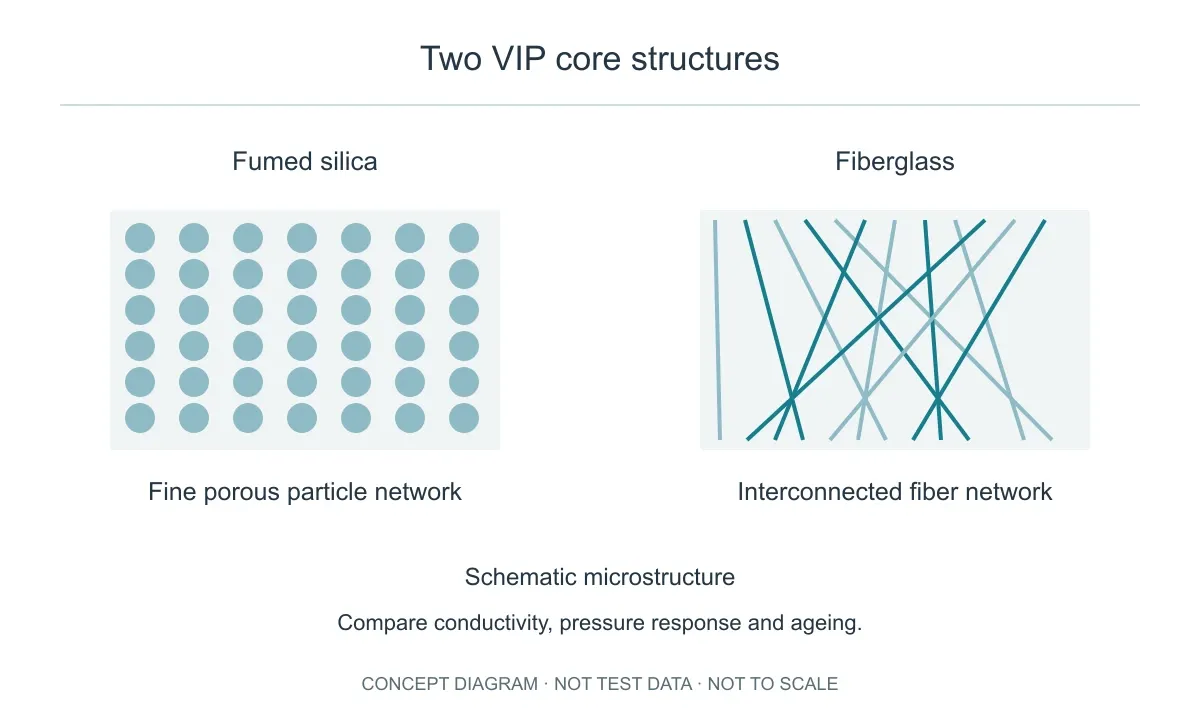
Fumed silica packs into a structure with pores of roughly 100–300 nm. Molecules hit pore walls before they hit each other, so gas conduction stays throttled even at internal pressures of several millibar. The panel does not need — and barely benefits from — a hard vacuum.
Glass fiber cores have pores in the micrometer range and beyond. At high vacuum there is simply too little gas to conduct, which is why their initial λ is the lowest of any commercial core. But as pressure creeps up over years of envelope permeation, gas conduction returns early — which is why fiberglass panels pair a high-barrier envelope with a getter that chemically absorbs incoming gas and extends the high-vacuum window.
What that means over a panel's lifetime
Every VIP envelope admits a tiny amount of gas per year; barrier film class and edge-seal quality set the rate. The two cores respond on different curves:
- A fiberglass panel starts exceptionally low and stays there for as long as the getter and envelope hold the vacuum — comfortably covering the 10+ year design life of a refrigerator or a validated shipping box fleet.
- A fumed silica panel starts higher but its λ curve is nearly flat across early-life pressure rise — which is why declared values for building applications (where EN 17140 expects decades of service) are quoted on fumed silica cores.
Neither curve is "better" in the abstract. The question is how many years of performance your application actually has to guarantee — and what each panel costs per year of that service.
Selection guide by application
Refrigerators, freezers and appliances → fiberglass
Volume-manufactured products with a 10+ year life cycle want the lowest λ per millimeter at the lowest panel cost — exactly the fiberglass profile. This is the core behind the thin-wall, high-capacity cabinets discussed inour insulation thickness explainer.
Cold-chain shipping boxes → fiberglass
Passive shippers are qualified for holding time, refurbished, and cycled — service life is measured in trips, not decades. The lowest λ maximizes holding hours per millimeter of wall; see how to choose a cold chain shipping box for the system-level math.
Building, facade and interior retrofit → fumed silica
A wall assembly cannot be re-opened to swap panels, so the declared value must survive 15–25+ years. Fumed silica's flat aging curve — and its graceful ≈ 20 mW/(m·K) fallback even if a panel is ever punctured — is why the building VIP standard EN 17140 is written around it.
Special cases
Hot process equipment and appliances beyond the standard −70 °C to +80 °C window use dedicated high-temperature VIP constructions (up to +800 °C with metal envelopes). For these, core choice follows the temperature specification — ask our engineers with your operating profile.
Specifying it right: three practical notes
- Compare aged values, not brochure values. Ask every supplier for center-of-panel λ and the declared/aged value for your service life and climate; a day-one number alone tells you little.
- State your design life in the RFQ. "Lowest λ" and "25-year declared value" lead to different cores — a supplier who asks which one you need is a good sign.
- Check the core is inorganic. Both cores compared here are non-combustible Class A materials; organic-filled boards behave differently in fire and aging.
Frequently asked questions
Which VIP core material has the lowest thermal conductivity?
Fiberglass (centrifugal glass fiber) cores reach the lowest initial center-of-panel values, typically 1.5–2.5 mW/(m·K). Fumed silica cores start higher, around 3.5–5 mW/(m·K), but hold their performance far longer as internal pressure slowly rises over the panel's life.
Why does a fumed silica VIP tolerate vacuum loss better than a fiberglass VIP?
Because of pore size. Fumed silica pores are around 100–300 nm — close to the mean free path of air molecules — so gas conduction stays suppressed even at internal pressures of several millibar (the Knudsen effect). Fiberglass cores have much larger pores and need a high vacuum, roughly below 0.1 mbar, supported by a getter, to deliver their headline performance.
Which core material should I choose for my application?
As a rule of thumb: fiberglass cores for appliances, cold-chain shipping boxes and other products with a 10+ year design life where the lowest possible λ and cost per panel matter most; fumed silica cores for building and construction applications where a declared service life of 15–25+ years is required, as reflected in the EN 17140 product standard for building VIPs.
Related: Supertech VIP specifications (both cores) ·VIP vs. traditional insulation — the numbers ·What is a vacuum insulation panel?
Product specifications: Fiberglass VIP specifications · Fumed silica VIP specifications.