
How to Calculate Effective Thermal Conductivity of a VIP
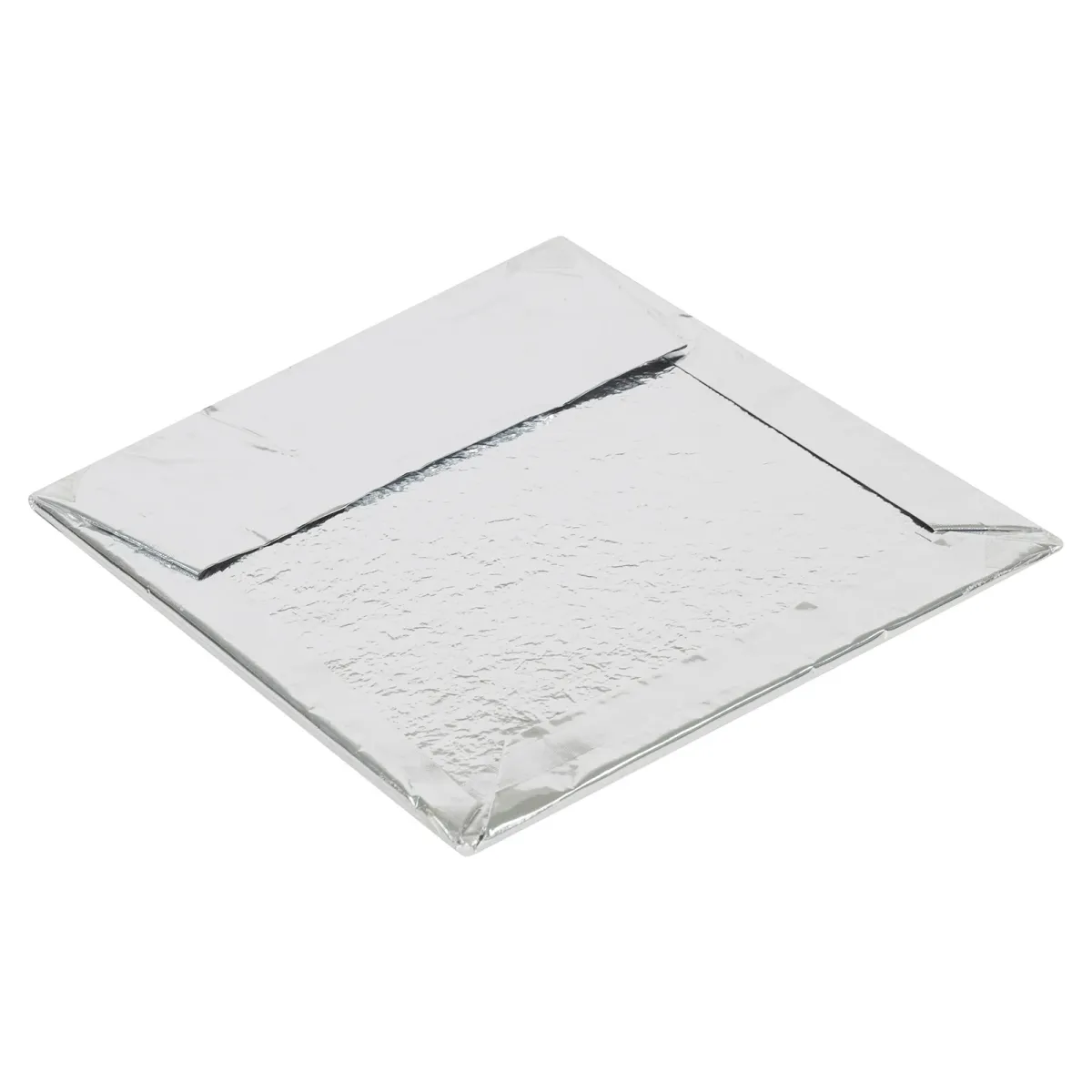
A centre-of-panel conductivity describes the insulated field, not every heat path around a finished vacuum insulation panel. For a preliminary comparison, combine that field with an edge contribution defined for the same construction and boundary conditions.
Which inputs define a VIP edge calculation?
- λcop
- Centre-of-panel conductivity, W/(m·K). State temperature, age and test method.
- ψ
- Additional linear edge transmittance, W/(m·K), relative to the chosen centre reference. It is not the conductivity of the metal film.
- d, A, P
- Panel thickness in m, reference face area in m² and perimeter of that same face in m. For a rectangle, A = L × W and P = 2(L + W).
How does the panel-edge term change effective conductivity?
For a steady-state screening model, add the centre and edge heat-transfer coefficients, then multiply by panel thickness:
U_panel ≈ λcop / d + ψ × P / A
λeff ≈ λcop + ψ × d × P / A
Use W rather than mW throughout the calculation. Convert the result to mW/(m·K) only at the end. U_panel here describes the modelled panel layer; it is not a whole-wall U-value with surface resistances, skins and fixings.
This model assumes a defined panel geometry and a compatible edge coefficient. If ψ varies along the perimeter, replace ψP with the sum of each ψᵢlᵢ. Unmodelled corner or point effects need separate treatment. A calculation does not replace representative testing.
Worked example: what changes when a VIP gets smaller?
Hypothetical inputs for all three rows: λcop = 0.004 W/(m·K), d = 0.020 m and ψ = 0.004 W/(m·K). These are arithmetic assumptions, not a Supertech grade, film ranking or measured product result.
| Panel L × W (m) | P/A (1/m) | λeff (mW/(m·K)) | Increase over λcop |
|---|---|---|---|
| 1 × 0.5 | 6 | 4.48 | +12% |
| 0.5 × 0.5 | 8 | 4.64 | +16% |
| 0.25 × 0.25 | 16 | 5.28 | +32% |
For the 1.00 × 0.50 m panel: A = 0.50 m² and P = 3.00 m. The edge addition is 0.00048 W/(m·K), giving λeff = 0.00448 W/(m·K). The modelled panel resistance is d/λeff ≈ 4.46 m²·K/W, versus 5.00 using the centre value alone.
A 12% increase in conductivity does not mean a 12% loss of thermal resistance: in this example the resistance reduction is about 10.7%. Neither percentage predicts the energy use of a refrigerator or the holding time of a shipper.
Does a larger or thicker VIP always solve the edge problem?
At fixed d, λcop and ψ, a lower P/A reduces the edge addition. Real design also includes handling, available formats, openings and replacement access. Do not extrapolate the same ψ to a different thickness: the edge geometry and temperature field change. Compare the complete resistance or heat flow for each proposed construction.
What ψ values are published for foil and metallized-film VIPs?
Empa (Simmler & Brunner, 2005) published safe-side design values for building VIPs, calculated and experimentally verified: ψ = 0.07 W/(m·K) for aluminium-foil envelopes and ψ = 0.01 W/(m·K) for metallized polymer films. The difference is the metal: foil laminates contain a continuous aluminium foil of about 6–8 µm, while metallized high-barrier films carry up to three aluminium layers of 30–100 nm each (IEA Annex 39).
The table applies those two published ψ values to the same hypothetical inputs used above: λcop = 0.004 W/(m·K) and d = 0.020 m. Cells show λeff in mW/(m·K) and the increase over λcop.
| Panel L × W (m) | Metallized film, ψ = 0.01 | Aluminium foil, ψ = 0.07 |
|---|---|---|
| 1 × 0.5 | 5.2 (+30%) | 12.4 (+210%) |
| 0.5 × 0.5 | 5.6 (+40%) | 15.2 (+280%) |
| 0.25 × 0.25 | 7.2 (+80%) | 26.4 (+560%) |
These are conservative design values from 2005, not measurements of a current film, a Supertech panel or a stainless-steel envelope. Welded steel envelopes, newer laminates and other thicknesses need their own ψ. Use the comparison to see why the envelope matters, then ask for ψ or a whole-panel result for the actual construction.
How can you avoid counting a VIP joint twice?
Choose one consistent model. Either assemble effective panel values with only additional bridges not already included, or start from centre values and add a joint model that includes the necessary edge contributions. Do not add two single-panel edge terms and then add a joint coefficient that already contains those same edges. Two adjacent panel perimeters are not automatically the same reference as one measured assembly joint.
What evidence should accompany a VIP effective value?
- A drawing defining the reference area, perimeter, seams, protective layers and installation gaps.
- Centre data and ψ or whole-panel resistance at compatible temperatures, sample age and thickness.
- The coefficient derivation, reference construction, boundary conditions and measurement or model uncertainty.
- A clear statement of whether ageing, panel edges, assembly joints, facings, fixings and surface resistances are included.
ASTM C1667 addresses centre-of-panel heat-flow-meter testing. ISO 16478:2023 includes edge-bridge and ageing assessment within its building-VIP scope; it does not qualify a complete appliance or shipping box. China's GB/T 39704-2020 (issued 2020-12-14, in force since 2021-11-01) specifies how to determine VIP effective thermal conductivity including the influence of the barrier-film edge, either by measurement or by calculation from barrier-film data.
Frequently asked questions about VIP effective conductivity
Can the same ψ be assigned to every aluminium or steel VIP?
No. Material names do not define the envelope thickness, seams, core, panel thickness or boundary conditions. Request a coefficient or effective result for the relevant construction.
Does the edge correction include loss of vacuum over time?
Not by itself. Centre conductivity and edge data must have an explicit age and service basis. Gas ingress and conductive edge heat flow are different mechanisms.
Is λeff enough to predict cold-chain holding time?
No. A complete pack-out also depends on coolant, payload, starting conditions, geometry, openings and ambient profile. Validate the complete shipping system.
Compare VIP layouts using the same thermal boundary
Send your panel drawing, available thickness, operating temperatures, expected service conditions and target assembly performance. Ask for the evidence needed to compare the proposed panel sizes rather than selecting by centre conductivity alone.
- Explore VIP product families
- Request technical documents
- Discuss a panel layout
- Edge leakage versus thermal bridges
- Insulation thickness calculator
Technical references
- Tenpierik & Cauberg (2007): Analytical Models for Calculating Thermal Bridge Effects Caused by Thin High Barrier Envelopes around Vacuum Insulation Panels.
- ISO 16478:2023 — Vacuum insulation panels: specification.
- ASTM C1667-15(2023) — Centre-of-panel thermal transmission measurement.
- Simmler & Brunner (2005): Vacuum insulation panels for building application — basic properties, aging mechanisms and service life. Energy and Buildings 37, 1122–1131.
- IEA EBC Annex 39, Subtask A report: High Performance Thermal Insulation — VIP components and panels.
- GB/T 39704-2020 — Determination of effective thermal conductivity for vacuum insulation panels (VIP), 真空绝热板有效导热系数的测定.