
VIP Edge Leakage vs. Edge Thermal Bridges: How to Compare Designs
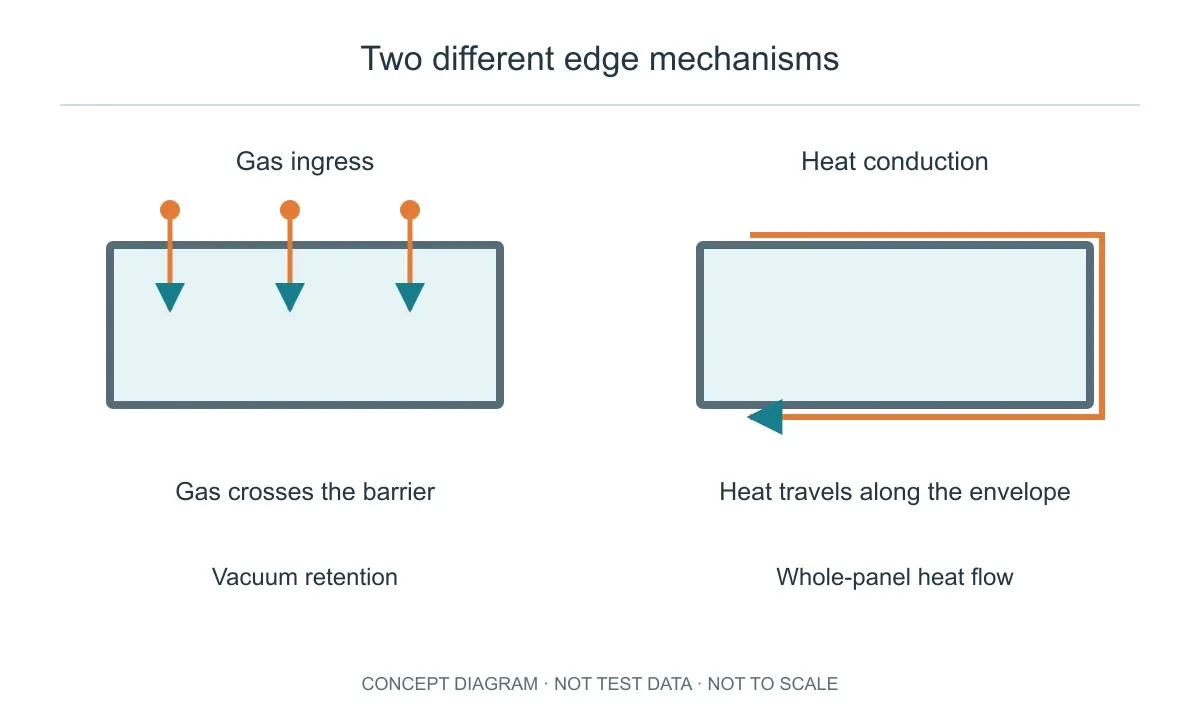
What buyers need to separate
- Edge leakage changes the vacuum and therefore the panel's performance over time.
- Edge thermal bridging bypasses the core even when the vacuum remains intact.
- A fold-free prefabricated shell can reduce corner-fold stress, but it does not remove every leakage or heat-transfer path.
- Aluminum-rich barriers generally improve impermeability while increasing conductive edge heat flow; the best balance depends on geometry and service conditions.
- Compare identical finished panels and assemblies. A center-of-panel lambda value or raw-film transmission value cannot settle the design choice alone.
“Edge loss” describes two different engineering problems
A vacuum insulation panel combines an evacuated porous core with a sealed high-barrier envelope. At the perimeter, two failure mechanisms are often compressed into the same phrase: “edge loss.” That ambiguity can lead a buyer to improve one property while unknowingly worsening another.
| Question | Edge leakage / permeation | Edge thermal bridge |
|---|---|---|
| Physical mechanism | Gas or water vapor enters through film, seal, fold or damage | Heat conducts through envelope, seam, joint or fixing |
| Time dependence | Usually accumulates through aging; damage can cause rapid failure | Present from the start and changes with geometry and materials |
| What it changes | Internal pressure, moisture content and center performance | Whole-panel or assembly heat flow while the center may remain unchanged |
| Useful evidence | Aged conductivity, mass uptake, vacuum retention, leak and failure data | Linear transmittance, effective conductivity, guarded hot plate or hot-box assembly result |
Why conventional bag-type VIPs use folded edges
In a conventional bag construction, a flat laminate is formed around a core, evacuated and heat sealed. The excess envelope is then folded against the panel. This is economical and flexible, but the corners experience tight bending, overlapping layers and local stress during handling. A crease, abrasion or imperfect seal can become a faster ingress path than the undamaged face laminate.
The fold itself is not proof of poor durability. A qualified bag-type VIP can perform reliably when the laminate, bend radius, seal process and protection system are matched. The engineering question is whether production and handling controls keep those local features inside the accepted failure rate.
What a fold-free prefabricated shell changes
A prefabricated base-shell design forms the corners before the core is loaded and uses a comparatively flat perimeter flange for the final seal. The VAP-AL concept described in the source material follows this architecture with an aluminum-plastic laminate. Removing the post-sealing corner fold can make geometry more repeatable and reduce damage introduced by folding, transport or assembly.
That is a design hypothesis to verify, not a universal result. Buyers should still examine the formed corner thickness, seal transition, top-film interface, puncture protection, production tolerances and performance after thermal cycling. Current project decisions should rely on the applicable datasheet and representative finished-panel tests rather than a product-family name.
The barrier trade-off: vacuum retention versus edge conduction
The envelope must slow oxygen, nitrogen and water-vapor ingress for the intended service period. Aluminum-foil laminates are strong barriers, but a continuous conductive layer also connects the hot and cold faces around the panel perimeter. Metallized polymer films use much thinner deposited metal layers and can reduce this bypass. Aluminum-free and oxide-coated alternatives move the trade-off again, with different forming, sealing and aging behavior.
ASTM C1667 measures thermal transmission at the center of a flat VIP. It explicitly treats that result as only one input to effective panel resistance. For a simplified rectangular panel, the effective heat-transfer coefficient can be viewed as the center term plus an edge term:Ueff = λcop/d + ψ × P/A, where d is thickness, ψ is linear edge transmittance, P is perimeter and A is area. The relationship explains why identical center values can produce different installed results.
Geometry can reverse an apparently simple material choice
- Smaller panels: higher perimeter-to-area ratio makes the edge term more important.
- Thinner panels: save space but can make dimensional control, wrinkles and edge contribution more influential.
- Larger panels: reduce edge length per square metre but can be harder to protect, fit and replace.
- Wide joints or gaps: create an assembly bridge that a good single-panel result does not capture.
- Fasteners and facings: can add linear or point bridges outside the VIP envelope itself.
ISO 16478:2023 addresses aging factors and linear edge bridges for building VIPs. Its method is useful context, but its declared scope is building products with silica or glass-fiber cores. Appliances, transport equipment and cold-chain systems still require application-specific assembly validation.
A five-stage comparison that avoids brochure bias
- Lock the comparison: use the same core, thickness, length, width, mean test temperature and sample age.
- Measure the center: establish initial and aged center-of-panel conductivity with the method and uncertainty reported.
- Quantify the edge: report linear transmittance or effective whole-panel resistance for the actual envelope and seam geometry.
- Stress the finished panel: combine relevant temperature/humidity exposure with bending, vibration, impact or compression from the real logistics and assembly process.
- Test the final assembly: include joints, fillers, facings, foam encapsulation, fasteners and service gaps in an energy or thermal-duration test.
Report sample count and individual failures, not only the average of surviving specimens. A design that gives a slightly better mean result but a wider failure distribution may be the wrong choice for a high-volume appliance cabinet or an inaccessible building component.
Which evidence matters by application?
| Application | Dominant edge risk | Useful system-level check |
|---|---|---|
| Refrigerator or freezer | Cabinet forming, foam pressure, seams and cut-outs | Cabinet energy test plus post-foaming panel audit |
| Reusable cold-chain shipper | Repeated impact, cleaning, panel replacement and corner gaps | Qualified pack-out thermal test after simulated reuse |
| Building element | Joints, fixings, moisture, site damage and long service period | Declared edge-adjusted value plus component or hot-box assessment |
| Transport or equipment panel | Vibration, curved interfaces, fasteners and temperature cycling | Representative panel assembly under mechanical and thermal duty |
Eight RFQ fields for comparing edge designs
- Panel identity: core, envelope layer family, formed-shell or bag construction, seal type and getter/desiccant.
- Geometry: finished dimensions, thickness, corner radius, seal width, flap or flange arrangement and tolerances.
- Initial thermal data: center value, mean temperature, method, sample age and measurement uncertainty.
- Effective result: whole-panel conductivity/resistance or linear edge transmittance for each required size.
- Aging conditions: temperature, humidity, duration, cycles, pre/post results, sample count and failures.
- Mechanical evidence: puncture, seal strength and results after relevant drop, vibration, compression or forming simulation.
- Acceptance criteria: visual defects, leak or vacuum-retention limit, thermal threshold and lot-sampling plan.
- Assembly validation: joint layout, protection method and the final product test that closes the specification.
Frequently asked questions
Is VIP edge leakage the same as the edge thermal-bridge effect?
No. Edge leakage means gas or water vapor enters through a seal, fold or damaged corner and degrades the vacuum over time. An edge thermal bridge is heat conducted around the low-conductivity core by the envelope, seam, joint or adjacent material. One is a durability problem; the other is an effective thermal-performance problem.
Does an aluminum-laminate envelope always make a better VIP?
Not automatically. Aluminum foil can provide strong gas and moisture barrier performance, but its higher in-plane conductivity can increase edge heat transfer. Metallized polymer or aluminum-free films can reduce that thermal bridge but may require a different aging design. Compare the finished panel, not one film property.
What does a fold-free shell change in a vacuum insulation panel?
A preformed shell can remove corner folds and keep the sealing flange flatter and more repeatable. That may reduce fold damage and handling-related leakage paths. It does not eliminate permeation, seal qualification, puncture risk or the thermal bridge created by a conductive barrier and surrounding assembly.
What data should buyers request when comparing VIP edge designs?
Request center-of-panel conductivity, effective whole-panel or linear edge transmittance, sample dimensions, envelope and seam definition, initial and aged results, sample count and failures, temperature and humidity conditions, leak or vacuum-retention evidence, and mechanical results after transport and assembly simulation.
References
- ISO 16478:2023 — VIP specification including aging factors and the influence of linear edge thermal bridges for its building-product scope.
- ASTM C1667-15(2023) — center-of-panel thermal transmission measurement and its relationship to effective panel resistance.
- Tenpierik & Cauberg (2007) — analytical models for thermal bridges created by high-barrier VIP envelopes.
- Gonçalves et al. (2022) — experimental and numerical analysis of panel dimensions, edge materials, joints and fixings.
- Super Tech source article — description of the fold-free VAP-AL base-shell concept; request the current project datasheet for specification values.
Related: Supertech vacuum insulation panels ·How to verify a VIP lifespan claim ·Fumed silica vs. fiberglass cores ·Compare panel constructions for your application
Product specifications: VAP aluminum and stainless-steel series.