
50 mm VIP vs. 150 mm Rock Wool: The Industrial Energy-Saving Math
TL;DR
- On a modelled 10,000 m² hot-process surface (300 °C process, 30 °C ambient), 150 mm rock wool still leaks 720 kW — like running 720 one-kW heaters around the clock.
- A 50 mm metal VIP layer cuts that to 108 kW: ≈ 85% less heat loss at one third of the thickness.
- At an assumed $0.10/kWh, that is roughly $540,000 per year in avoided electricity — plus ≈ 2,250 tonnes of CO₂.
- VIPs cost more upfront; on continuous high-ΔT equipment the typical payback is 2–3 years.
- The often-ignored bonus: 100 mm of reclaimed clearance, lighter supports and easier installation.
The scenario
A plant's energy audit shows a large share of its electricity bill leaking through underperforming insulation on hot process equipment. This is one of the most common findings in industrial energy audits — and one of the cheapest to fix per kilowatt-hour saved. To show why, here is a worked steady-state model comparing the incumbent solution with a vacuum-insulated one.
| Insulated surface area | 10,000 m² |
|---|---|
| Process / ambient temperature | 300 °C / 30 °C (ΔT = 270 K) |
| Operating hours | 8,760 h/year (continuous) |
| Electricity price (assumption) | $0.10 per kWh |
| Option A | 150 mm rock wool, λ ≈ 0.04 W/(m·K) |
| Option B | 50 mm metal-envelope VIP, λ ≈ 0.002 W/(m·K) |
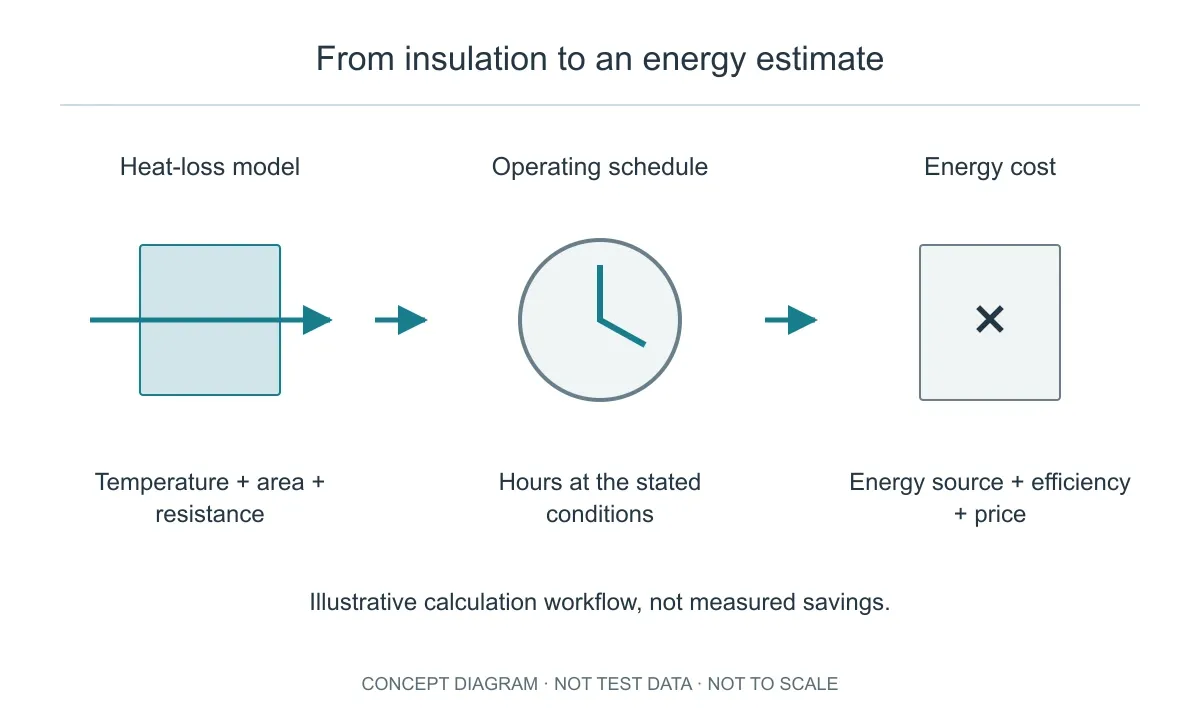
Step 1 — Heat transfer coefficient (K = λ ÷ d)
Rock wool: 0.04 ÷ 0.15 = 0.267 W/(m²·K). Metal VIP: 0.002 ÷ 0.05 =0.040 W/(m²·K). The rock wool wall transmits heat about 6.7 times faster — despite being three times thicker. Thickness cannot buy back what conductivity gives away; the general math is in our insulation thickness explainer.
Step 2 — Heat loss power (Q = K × A × ΔT)
Rock wool: 0.267 × 10,000 × 270 ≈ 720 kW. Metal VIP: 0.040 × 10,000 × 270 ≈108 kW. Every one of those kilowatts must be replaced by the heating system, hour after hour, all year.
Step 3 — What that costs per year
| Metric | 150 mm rock wool | 50 mm metal VIP | Difference |
|---|---|---|---|
| Heat transfer coefficient | 0.267 W/(m²·K) | 0.040 W/(m²·K) | −85% |
| Heat loss power | 720 kW | 108 kW | −612 kW |
| Electricity lost per year | ≈ 6.31 GWh | ≈ 0.95 GWh | −5.36 GWh |
| Cost at $0.10/kWh | ≈ $631,000 | ≈ $95,000 | ≈ $536,000 saved |
| CO₂ at 0.42 kg/kWh (grid assumption) | ≈ 2,650 t | ≈ 399 t | ≈ −2,250 t |
| Wall build-up | 150 mm | 50 mm | −100 mm |
Three values the spreadsheet misses
- Equipment life. Less heat loss means the heating system spends less time at full load — slower aging, fewer maintenance stops.
- Process stability. High-temperature processes want temperature uniformity; a poorly insulated shell fluctuates, and yield losses from that are usually harder to see than the electricity bill.
- Carbon position. Where carbon markets or carbon taxes apply, ≈ 2,250 avoided tonnes per year is a tradable or tax-relevant asset, not just a footnote.
The honest caveats
This is a steady-state model, and four things move real-world numbers: thermal bridges at panel edges, joints and fasteners raise the effective system value above the center-of-panel figure; λ varies with temperature, so hot-face values differ from laboratory ones; the model assumes 24/7 operation — intermittent processes save proportionally less; and upfront cost is higher for VIP, which is why the right comparison is life-cycle cost, not purchase price. On that basis, the group's published case analysis puts typical payback for continuous high-ΔT equipment at 2–3 years.
Where this applies
The model uses the high-temperature metal-envelope VIP series (−196 °C to +800 °C) — the panel family built for process equipment, ovens and hot piping. For the standard −70 °C to +80 °C range, the same economics logic applies withstandard laminated-film VIPs at even lower λ. If you have an audit report with a heat-loss line item, send us the operating profile — surface area, temperatures, hours — and we will run this calculation with your numbers.
Frequently asked questions
Can a 50 mm VIP really replace 150 mm of rock wool?
Thermally, yes — with margin. At typical values (rock wool λ ≈ 0.04 W/(m·K), metal VIP λ ≈ 0.002), the 150 mm rock wool layer has a heat transfer coefficient of about 0.267 W/(m²·K) while the 50 mm VIP reaches about 0.040 — roughly 6.7 times less heat loss from one third of the thickness. Real installations must additionally account for thermal bridges at joints and fasteners.
What is the payback period for VIP insulation on industrial equipment?
VIPs cost more upfront than mineral wool. But on continuously operating high-temperature equipment, the energy saving is so large that the group's published case analysis puts the typical payback at 2–3 years — after which the saving is annual profit for the rest of the service life.
Do vacuum insulation panels work at 300 °C process temperatures?
Standard laminated-film VIPs serve −70 °C to +80 °C. Hot process equipment uses the dedicated high-temperature series with metal envelopes, which covers −196 °C to +800 °C — the panel type this model is based on.
References
- ISO 6946 — Building components and building elements. Thermal resistance and thermal transmittance. Calculation methods (steady-state K/U methodology).
- Super Tech Group case analysis: 50 mm metal VIP as a 150 mm rock wool replacement (source of the model parameters and payback figure).
Related: VIP vs. traditional insulation — the numbers ·Insulation thickness, explained ·Applications overview