
Vacuum Insulation Panels for Heat Pump Water Heaters and Storage Tanks
TL;DR
- VIP + PU composite insulation is worth evaluating when tank diameter or insulation space is constrained.
- Lower standing heat loss, a smaller casing and greater usable capacity are separate design objectives, not automatic simultaneous benefits.
- Narrow flat VIP segments can surround a cylinder; PU fills and protects the remaining spaces.
- Use comparable whole-unit prototypes to confirm the benefit, including connections, supports, aging and manufacturing effects.
Why heat retention matters alongside heat pump efficiency
A heat pump produces heat; the storage tank must retain it until it is needed. Even without water draw-off, heat escapes through the sidewall, top, bottom, connections and supports. Better insulation may reduce reheating demand, but the electricity outcome also depends on operating conditions, control settings and water use.
Conventional polyurethane (PU) foam fits established manufacturing processes. Increasing its thickness can compete with installation space or useful tank volume. A vacuum insulation panel (VIP) offers a route to higher thermal resistance in a limited space. Research has explored VIP insulation for thermal storage, but literature results are not performance guarantees for a new tank design.
How VIP and PU work together
A VIP contains an evacuated core inside a sealed barrier envelope. Select the complete panel construction for its operating temperature, aged performance and edge effects, not only its initial center-of-panel conductivity. Our VIP introduction explains the components.
In the proposed composite structure, VIPs increase resistance across selected main surfaces. PU fills gaps between panels, the curved tank and the casing, while helping protect and locate the panels. Foam does not remove all thermal bridges: panel joints, brackets and pipe connections still need attention.
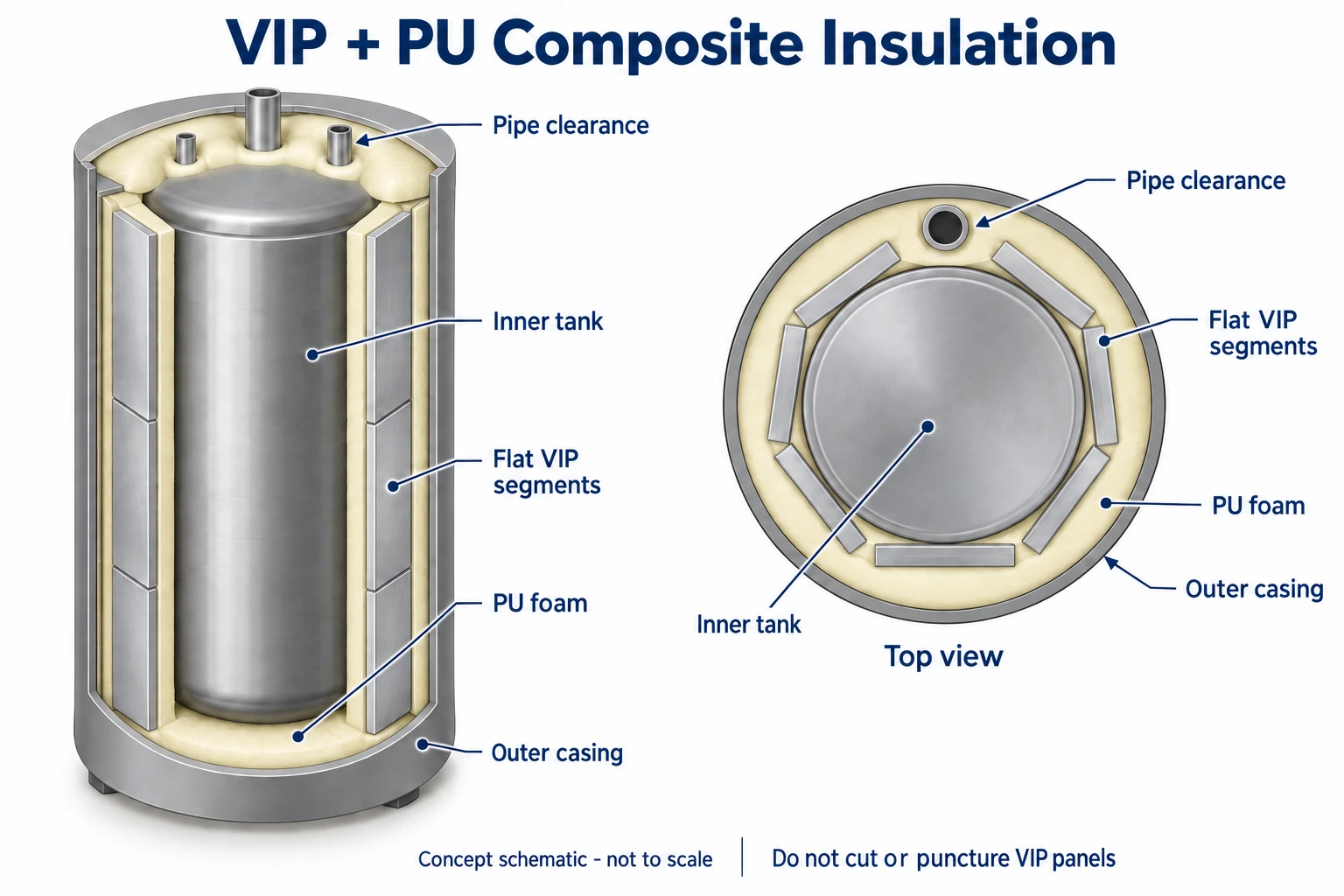
Arrange flat panels around the cylinder
Multiple narrow panels form a polygon around the inner tank. Space between each flat panel and the curved surface remains available for foam. Narrower panels may improve geometric fit, but increase panel count, total sealed-edge length and handling operations. Compare widths, thicknesses, gaps and coverage as one design problem.
| Area | Design approach | Check before approval |
|---|---|---|
| Sidewall | Segmented flat VIPs in suitable areas | Coverage, gaps, seal protection and assembly tolerance |
| Top and bottom | Retain foam or specify custom panel geometry | Local temperatures, supports and available space |
| Pipes, flanges and sensors | Reserve connection and maintenance clearances | Heat bridges and access without damaging panels |
| Foamed assembly | Locate and protect panels before foaming | Process heat, pressure, chemical compatibility and handling damage |
Check the maximum local temperature near heaters, heat exchangers and connections, including abnormal or disinfection cycles where applicable. The water setpoint alone does not establish panel suitability. Final panel shapes must be specified before production; field cutting or drilling destroys the vacuum envelope.
A study of a double-wall vacuum-insulated water tank identified the bottom and supports as important heat-loss paths. That construction is different from segmented VIP + PU, but it reinforces the need to test the whole tank rather than infer its result from sidewall insulation alone. See also VIP edge leakage versus thermal bridges.
Where the concept is most useful
Good candidates for an initial feasibility review include premium heat pump water heaters, compact hot water cylinders and long-duration solar or multi-source thermal stores. Price-sensitive products should first compare additional panel and assembly cost with the value of lower loss or reduced dimensions.
For PCM thermal batteries, phase change provides heat storage while insulation limits exchange with the surroundings. Flat-sided modules may simplify panel placement. Compare usable heat, time within the target temperature window, charge and discharge power, and complete equipment volume. PCM core energy density alone does not establish the advantage of the finished product.
Build an A/B prototype comparison
- Choose one target: lower standing loss at unchanged size and capacity, or a size/capacity change at an agreed loss target.
- Document the baseline: drawings, connections, insulation, usable capacity, external dimensions, operating temperatures and production process.
- Make comparable units: retain a conventional baseline A and create a VIP + PU variant B. Record any differences that prevent a direct comparison.
- Define the measurement: agree on water and ambient temperatures, initial stratification, stabilization, no-draw conditions, connection configuration, instrument accuracy and the applicable product test method.
- Measure and condition: compare whole-unit heat loss, investigate local heat paths, then repeat relevant checks after thermal cycling, foaming, assembly and transport exposure.
- Decide on production: balance verified performance against panel count, material cost, assembly time, scrap risk and service access.
Start with a defined product and drawing
Send your tank layout, available insulation space, temperature profile and target standing loss to discuss a prototype. Our VIP product overview is a starting point; confirm the exact core, barrier, dimensions and service conditions for the proposed assembly. For longer-term evidence, use the VIP service-life verification checklist.
Frequently asked questions
Can flat VIPs insulate a cylindrical hot water tank?
Yes, a proposed layout uses narrow flat panels arranged as a polygon around the cylinder, with PU filling the remaining space. Panel width, gaps, edge length and assembly tolerances must be evaluated together. Flat panels must not be forced to curve around the tank.
Should VIP completely replace polyurethane insulation?
Not necessarily. A composite design uses VIPs in suitable surface areas and PU for gap filling, protection and positioning. Connections, supports, complex shapes and service zones still need dedicated insulation design.
What information is needed to evaluate a VIP water tank prototype?
Provide tank drawings, usable capacity, external dimensions, insulation space, connection and support locations, operating and peak temperatures, baseline standing loss, manufacturing process and cost target. Agree on a comparable baseline and prototype test before selecting panel sizes.
References
- Fuchs, Hofbeck & Faulstich (2012): VIP applications in thermal storage, Energy Procedia.
- Experimental Study of a Small-Size Vacuum Insulated Water Tank (2021): whole-tank testing and thermal bridges; a double-wall vacuum design, not this composite concept.