
VIP Getters and Desiccants: How to Specify Gas Control
TL;DR
- A getter or desiccant is a finite gas-management reserve, not a substitute for a qualified envelope, seal and evacuation process.
- The design gas load has four main sources: residual gas, material outgassing, permeation through the barrier and permeation through the seal.
- Desiccants primarily control water vapor; getters target selected dry gases or multiple gas species. The chemistry must match the actual gas composition.
- Fiberglass cores generally require lower internal pressure than fumed-silica cores, so identical adsorbent systems can produce very different service lives.
- Buyers should evaluate aged finished panels. A getter ingredient list or single capacity value cannot prove long-term VIP performance.
The getter is part of a gas-control system
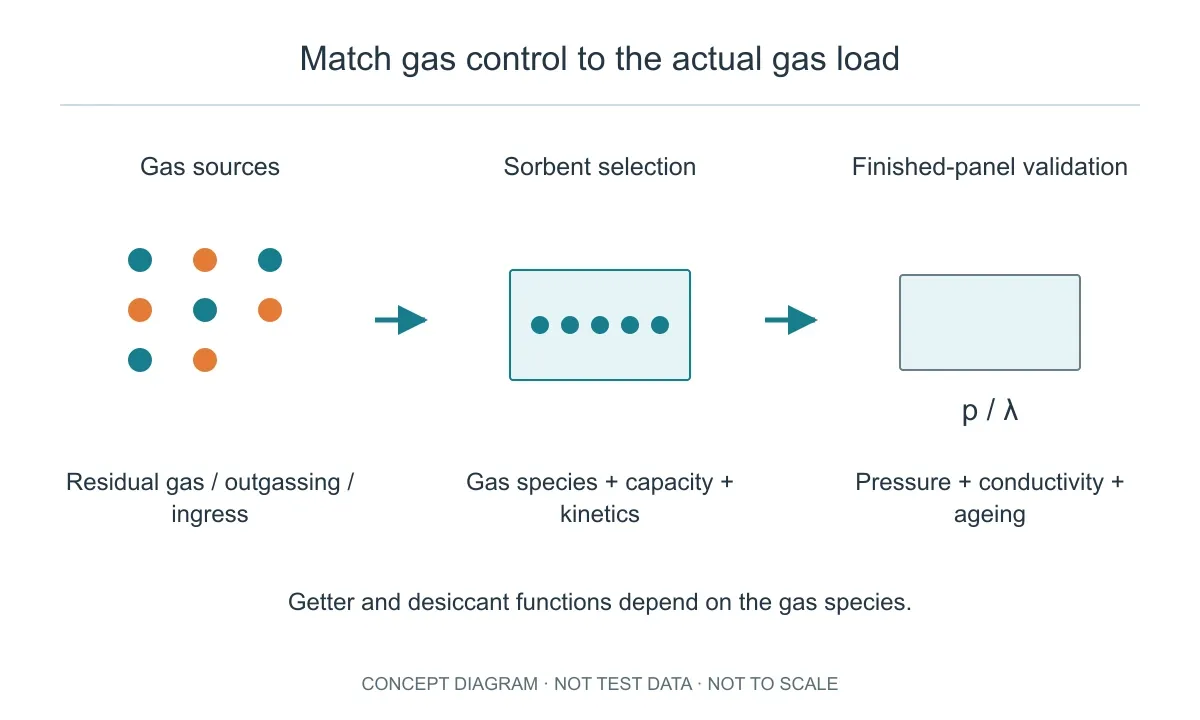
A vacuum insulation panel works by suppressing gas conduction inside a porous core. The envelope and heat seal slow gas entry, while manufacturing removes as much initial gas and moisture as practical. The getter or desiccant then captures a defined portion of what remains or enters later. Treating it as a stand-alone “vacuum improver” hides the real design problem: every panel has a gas budget, and every sorbent has finite capacity.
Where does the internal gas come from?
| Gas source | Typical cause | Primary control | Role of sorbent |
|---|---|---|---|
| Residual gas | Incomplete evacuation and trapped gas after sealing | Evacuation cycle, conductance and process control | Captures selected residual species |
| Outgassing | Moisture or volatiles released by core, film and internal parts | Drying, bake-out, clean materials and storage control | Buffers the qualified residual load |
| Surface permeation | Gas and water vapor diffusing through the barrier laminate | Barrier construction and service protection | Delays the resulting pressure or moisture rise |
| Seal permeation | Ingress through the heat-seal perimeter and formed details | Seal material, width, geometry and process capability | Provides reserve for the predicted ingress rate |
| Gross leak | Puncture, open seam or handling damage | Protection, inspection and rejection criteria | Not a credible remedy |
A useful first-order mass balance is: required sorption capacity ≥ initial residual load + outgassing load + expected permeation over the design period + safety margin. Each term depends on gas species and temperature. A single “grams adsorbed” figure without that context is not a service-life calculation.
Getter, desiccant and multifunctional adsorbent are not synonyms
A desiccant is selected mainly for water vapor. A getter captures specific gas molecules by physical adsorption, chemisorption or reaction, depending on its formulation and activation state. Oxygen, nitrogen, hydrogen, carbon oxides and water vapor do not behave identically, so one ingredient rarely has the same capacity and kinetics for every species. Multifunctional systems combine materials to cover the gas mixture expected inside the panel.
The distinction matters in an RFQ. “Getter included” does not explain which gases are controlled, whether thermal activation is required, how the material is protected before sealing or how much usable capacity remains after production. Those details determine whether the component matches the panel rather than merely appearing on the bill of materials.
Core material changes the allowable pressure
Gas conduction depends on internal pressure and pore size. Fiberglass cores contain larger pores and normally need a deeper, more stable vacuum to retain their very low initial conductivity. Fumed silica has much smaller pores and suppresses gas conduction over a wider pressure range, although moisture can still increase its solid conduction. This is why a getter package that is adequate for one core cannot be transferred to another without recalculating the gas budget.
| Design factor | Fiberglass-core VIP | Fumed-silica-core VIP |
|---|---|---|
| Pressure sensitivity | High; performance responds early to pressure rise | Lower over the useful vacuum range |
| Typical priority | Dry-gas gettering plus moisture control | Moisture control and qualified barrier aging |
| Useful validation | Internal-pressure trend and aged conductivity | Moisture uptake, aged conductivity and pressure trend |
| Transferability | Do not transfer a capacity claim without matching core, panel geometry, envelope and service climate | |
Seven checks before specifying a getter system
- Define the gases: use residual-gas analysis or a justified material/process model rather than assuming air alone.
- Quantify the load: include initial residuals, outgassing and area- and perimeter-dependent permeation over the required life.
- Match the chemistry: state capacity and kinetics for each relevant gas at the expected pressure and temperature.
- Control activation: document activation temperature, time, atmosphere and the permitted interval before panel sealing.
- Protect the sorbent: define storage, handling and exposure limits so capacity is not consumed before evacuation.
- Check integration: confirm that particles, reaction products, packaging and placement do not damage the core, envelope or seal.
- Add a justified margin: base the margin on process variation and service uncertainty, not an unexplained multiplier.
Validate the finished panel, not only the powder
Sorption-capacity testing is component evidence. It should be followed by panel-level measurements that connect gas control to the performance the buyer actually needs. Useful programs combine initial internal pressure or center-of-panel conductivity with controlled aging at relevant temperature and humidity, then repeat the measurement. Representative size matters because barrier area, seal perimeter and core volume do not scale at the same rate.
Pressure-compensation, lift-off, embedded-sensor and thermal methods can all support vacuum-retention assessment when their limits are understood. For service-life claims, the report should state the end-of-life threshold, aging model, climate assumptions and individual sample failures. OurVIP lifespan verification guideexplains how to audit that evidence chain.
What vertical integration does — and does not — prove
Supertech produces VIP core material, barrier film, multifunctional getter and panel lamination within the same manufacturing platform. That makes it possible to tune the components as one system and trace changes across incoming materials, evacuation and finished-panel testing. It does not remove the need for application-specific qualification. Buyers should still request the current specification and aged results for the exact core, film, getter, dimensions and service conditions being quoted.
Eight RFQ fields that expose weak getter claims
- Panel identity: core, barrier, seal, getter/desiccant, dimensions and thickness.
- Target species: gases and moisture the formulation is intended to control.
- Usable capacity: capacity and kinetics at the stated pressure and temperature, not only a maximum laboratory value.
- Activation and handling: process window, storage life and pre-sealing exposure limit.
- Gas-load model: residual, outgassing, surface and edge permeation assumptions.
- Initial result: internal pressure and/or center conductivity with method, sample age and uncertainty.
- Aged result: temperature, humidity, duration, sample count, failures and pre/post values.
- End-of-life rule: the pressure or thermal threshold and prediction model used for the claimed service period.
Frequently asked questions
What is the difference between a getter and a desiccant in a VIP?
A desiccant is selected primarily to capture water vapor. A getter targets one or more residual or permeating gases through adsorption or chemical reaction. Some commercial formulations combine both functions, but the supplier should still state the target gases, capacity and operating conditions.
Can a getter save a vacuum insulation panel with a puncture?
No. A getter is a finite buffer for the expected gas load from residual gas, outgassing and slow permeation. A puncture or open seal admits far more gas than the getter is designed to manage, so a damaged panel normally has to be rejected and replaced.
Does every vacuum insulation panel need the same getter?
No. The correct system depends on core pore size, target pressure, envelope and seal permeance, panel geometry, manufacturing cleanliness, service temperature, humidity and required life. Fiberglass cores are generally more sensitive to pressure rise than fumed-silica cores and therefore need a different gas-control budget.
What getter evidence should a VIP buyer request?
Request the target gas species, sorption capacity and activation conditions, the panel gas-load assumptions, initial and aged internal-pressure or thermal-conductivity data, exposure conditions, sample dimensions, sample count and the end-of-life criterion. Powder capacity alone is not finished-panel proof.
References
- Baetens et al. (2010) — review of VIP components, getters/desiccants, aging mechanisms and service-life factors.
- Caps et al. (2008) — gas-pressure measurement methods and the relationship between pressure, pore size and thermal performance.
- Wei et al. (2020) — residual-gas analysis and composite-getter investigation for fiberglass-core VIPs.
- Yamamoto & Ogura (2022) — field pressure behavior and long-term modeling of fiberglass VIPs containing getters.
- Super Tech source article — original overview of in-house getter development; request current product data for project specifications.
Related: Supertech vacuum insulation panels ·Fumed silica vs. fiberglass cores ·VIP leakage vs. edge thermal bridges ·Request application-specific VIP data