
Vacuum Insulation for PCM Heat Batteries and Thermal Stores
Key facts: VIP insulation for PCM heat batteries
- A PCM heat battery stays near its melting temperature during standby, so it keeps losing heat at almost full rate. Insulation decides how much of the stored heat is still there when it is needed.
- In an illustrative 3 m² store at 58 °C, replacing 50 mm of PU with 30 mm PU + 20 mm VIP in the same thickness lowers the centre-of-wall loss from about 57 W to 25 W.
- Choose the VIP by its face temperature, not by the store set point alone. Fiberglass VIP: −70 to +100 °C (preferred −40 to +60 °C). Fumed silica VIP: −80 to +85 °C.
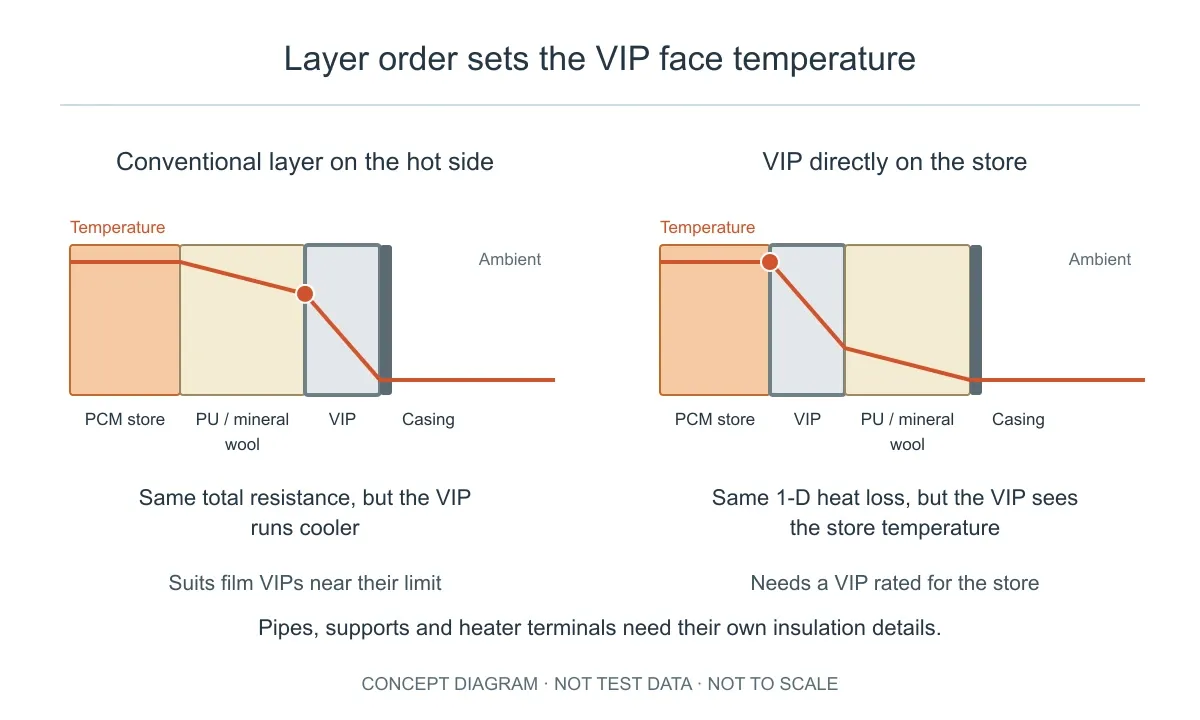
- A conventional layer on the hot side keeps the VIP cooler without changing the one-dimensional heat loss.
- For hotter stores, a welded stainless-steel M-VIP avoids the polymer barrier film; confirm its conductivity at the operating temperature.
- Pipe connections, supports and heater terminals often decide the final result, so test the whole unit.
What a PCM heat battery asks of its insulation
A heat battery stores heat in a phase change material (PCM). During charging the material melts; during discharge it solidifies again and releases its latent heat at an almost constant temperature. Salt hydrates such as sodium acetate trihydrate, which melts at around 58 °C, are a common choice for domestic hot water. Paraffins and other salt hydrates cover other temperature windows.
Three features make insulation more important here than in a conventional cylinder:
- The temperature stays high during standby. A water tank cools down as it loses heat, which slowly reduces the loss. A PCM store holds close to its melting temperature until the material has solidified, so the driving temperature difference barely falls.
- Heat is stored for later. Many heat batteries are charged with off-peak electricity, surplus photovoltaic power or a heat pump at its most efficient time, and are discharged hours later. Standing loss is paid for every hour in between.
- The product competes on size. A key selling point of a heat battery is that it is smaller than a cylinder of similar capacity. Thick foam takes back part of that advantage.
Many PCM stores are also built as rectangular boxes of stacked modules. Flat sides suit flat vacuum insulation panels (VIPs) far better than a cylinder, where flat panels must be arranged as a polygon. For cylindrical tanks, see our guide to VIP insulation for heat pump water heaters.
How much standing loss a VIP layer can remove from a PCM heat battery
The example below compares two wall build-ups of the same 50 mm thickness around a store with 3.0 m² of insulated surface, held at 58 °C in a 20 °C room. It is a simplified centre-of-wall calculation: surface resistances, the casing, edges, connections and supports are not included.
| Build-up (50 mm in total) | Thermal resistance | Heat loss | Per day |
|---|---|---|---|
| 50 mm PU, λ = 25 mW/(m·K) | 2.0 m²·K/W | ≈ 57 W | ≈ 1.4 kWh |
| 30 mm PU + 20 mm VIP, design λVIP = 6 mW/(m·K) | ≈ 4.5 m²·K/W | ≈ 25 W | ≈ 0.6 kWh |
The VIP design value of 6 mW/(m·K) is an assumption that allows for edges and ageing; the centre-of-panel value of Supertech fumed silica VIP is ≤ 4.5 mW/(m·K). For a store that holds 10 kWh of usable heat, the difference is roughly 14 % versus 6 % of the stored energy lost per day of standby.
For orientation: under Regulation (EU) No 812/2013 a hot water storage tank with a rated volume of 200 L must stay below about 32 W of standing loss for class A+ and about 44 W for class A (S < 5.5 + 3.16 · V0.4 and S < 8.5 + 4.25 · V0.4). The class of a real product depends on the test conditions of the applicable method and on how its volume is declared, not on the 38 K example above.
How to choose a VIP series by panel face temperature
A film-envelope VIP ages faster at higher temperatures because gas and water vapour pass through the barrier film more easily. What matters is the temperature at the panel face, which can be lower than the store temperature, and how long the panel spends there. The service ranges below are taken from the Supertech series specifications.
| Series | Conductivity (centre of panel) | Temperature range | Typical role in a heat store |
|---|---|---|---|
| Fiberglass VIP | 2.0 ± 0.5 / 1.8 ± 0.4 mW/(m·K) | Service −70 to +100 °C; preferred −40 to +60 °C | Lowest starting λ; keep the face temperature in the preferred range |
| Fumed silica VIP | ≤ 4.5 mW/(m·K) | −80 to +85 °C | Tolerates a pressure rise best; suits long design lives |
| Stainless-steel M-VIP | ≤ 2.0 mW/(m·K) at 25 °C | −196 to +800 °C (brochure) | No polymer film; for hot faces and high-temperature PCMs |
The M-VIP conductivity applies at 25 °C and must not be used across its whole temperature range. For a high-temperature store, ask for conductivity at the operating temperature and for the exposure duration that the data covers. See fumed silica vs fiberglass cores and what an M-VIP is for the core and envelope background.
Which layer order protects the VIP in a heat battery wall?
In a one-dimensional calculation the heat loss depends only on the sum of the layer resistances, not on their order. The order does decide how warm each layer gets. In the example above, about a quarter of the temperature drop occurs across the 30 mm PU layer and three quarters across the VIP:
- PU on the hot side: the VIP face sits at roughly 48 °C for a 58 °C store, and at roughly 68 °C for a store at 85 °C.
- VIP on the hot side: the VIP face is practically at the store temperature, 58 °C or 85 °C.
For a store near the upper limit of film VIPs, a conventional layer on the hot side is therefore the simplest way to keep the panel within its range. The outer layer still protects the panel against handling damage, and a rigid casing carries the mechanical loads. If the layer order cannot be arranged this way, or the store runs hotter, the metal-envelope VIP is the alternative.
How to detail the remaining heat paths around the VIPs
Once the main walls are insulated with VIPs, the remaining heat paths become a larger share of the total. Plan these points before the panel sizes are fixed:
- Pipe connections and heat exchanger headers: reserve space and insulate them separately; avoid metal brackets that bridge the VIP layer.
- Supports and feet: the weight of a PCM store is high, so use load-bearing insulation under the store and keep the VIPs out of the load path unless the panel is rated for it.
- Electric heater terminals, sensors and valves: check local temperatures, which can be well above the PCM melting point.
- Panel joints: stagger joints in two layers where possible and keep gaps small; panels cannot be cut or drilled on site.
- Service access: make inspection covers removable without disturbing the panels.
What to send for a heat battery insulation feasibility review
- Store dimensions, insulated surface areas and the space available for insulation.
- PCM type, melting temperature, maximum charging temperature and any peak or abnormal temperatures.
- Duty cycle: charging hours, typical standby time and expected design life.
- Connection, support and heater positions, with a drawing of the casing.
- Baseline standing loss and the target, with the test method you intend to use.
- Production process: whether the panels are foamed in, placed in a casing or wrapped.
Build a conventional unit A and a VIP unit B of the same design and compare the whole-unit standing loss under the same test conditions. Repeat key measurements after thermal cycling and transport. The VIP service-life checklist describes how to connect ageing tests to the service conditions.
Frequently asked questions
Why does a PCM heat battery need better insulation than a hot water tank of similar size?
A water tank cools as it loses heat, so its temperature difference to the room, and with it the heat loss, gradually falls. A phase change material stays close to its melting temperature while it releases latent heat. The store therefore keeps losing heat at almost full rate until the material has solidified. In addition, the store is often charged hours before the heat is used, for example with off-peak electricity or surplus photovoltaic power, so every hour of standby counts.
Which VIP type suits a PCM store charged to around 60 °C?
Film-envelope VIPs are the usual starting point. Supertech fiberglass VIP has a service range of −70 to +100 °C with a preferred range of −40 to +60 °C, and fumed silica VIP a service range of −80 to +85 °C. Placing a conventional insulation layer on the hot side keeps the VIP face below the store temperature. The panel construction should still be checked against the actual face temperature and the design life.
When should a metal-envelope VIP be considered?
When the panel face would be close to or above the limits of film VIPs, for example in stores charged by electric heaters or high-temperature heat pumps, or with phase change materials that melt above about 90 °C. The Supertech stainless-steel M-VIP brochure states a recommended range of −196 to +800 °C. Its conductivity of ≤ 2.0 mW/(m·K) applies at 25 °C only, so temperature-dependent data must be confirmed for the project.
Does the order of insulation layers change the heat loss?
In a simple one-dimensional calculation it does not: the total thermal resistance is the sum of the layers, whatever their order. The order does change the temperature each layer sees. Putting a conventional layer on the hot side lowers the temperature at the VIP face, which reduces the thermal stress on the barrier envelope.
How is the standing loss of a heat battery declared in the EU?
Hot water storage tanks are rated by their standing loss S in watts under Regulation (EU) No 812/2013, with class limits that depend on the rated storage volume. The measurement follows the test method that applies to the product type. For a PCM store, agree with the test laboratory how the storage volume is declared and which test method is used before the prototype is built.
References
- Commission Delegated Regulation (EU) No 812/2013 — Energy labelling of water heaters, hot water storage tanks and packages (Annex II, energy efficiency classes of hot water storage tanks).
- Commission Regulation (EU) No 814/2013 — Ecodesign requirements for water heaters and hot water storage tanks.
- EN 12897 — Water supply. Specification for indirectly heated unvented (closed) storage water heaters (includes the standing heat loss test).
- EN 17140 — Thermal insulation products for buildings. Factory-made vacuum insulation panels (VIP). Specification.
- RAL-GZ 896 — Phase change material. Quality assurance and test specifications.
Related: Vacuum Insulation Panels · VIP for Heat Pump Water Heaters · Edge Leakage vs. Thermal Bridges · Discuss your heat store